Robert Adams and the Moral Burden of Beauty
Robert Adams did not use beauty to redeem the damaged American West. He used it to keep us looking at what our appetite for progress had made.
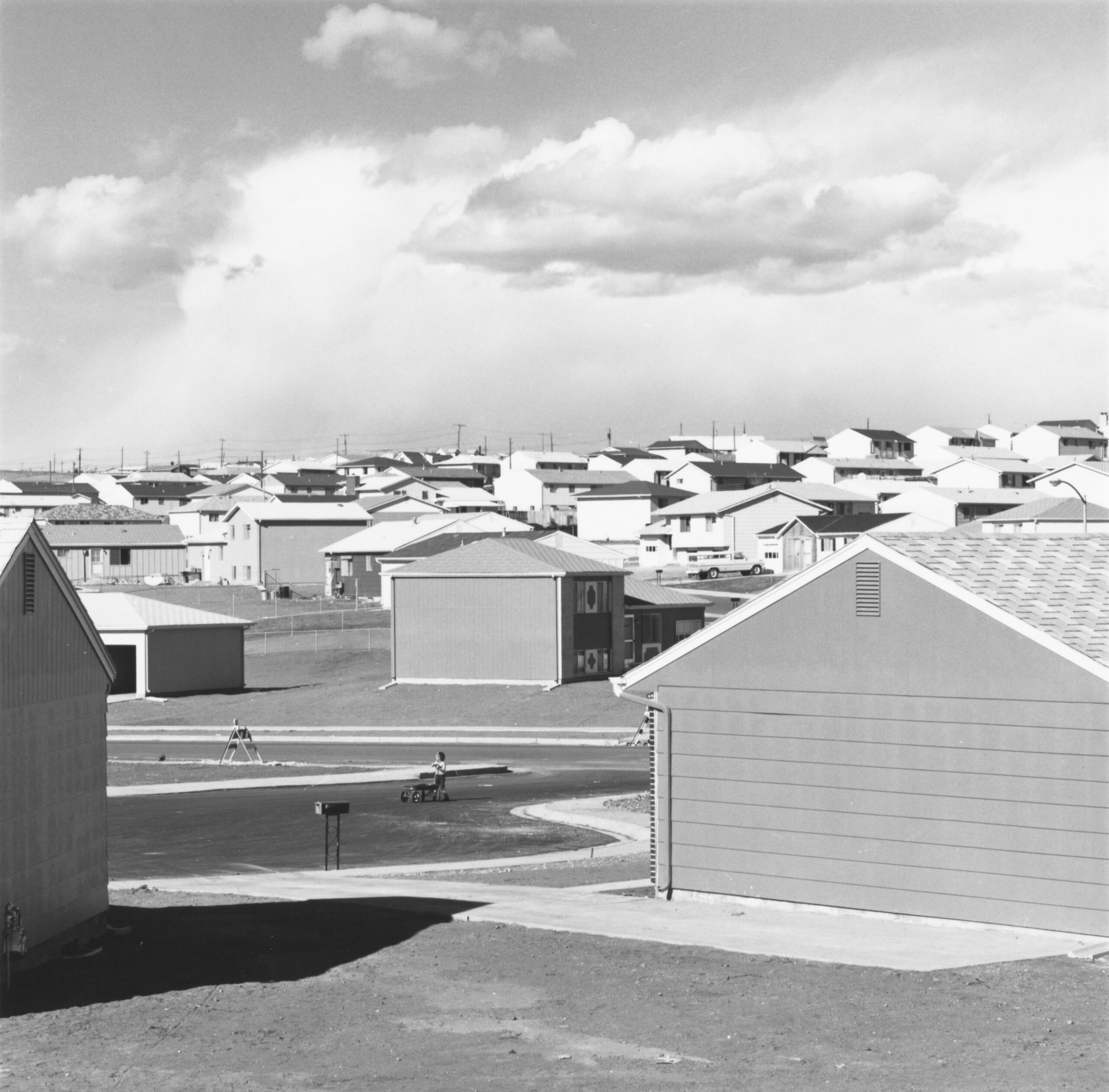
In Robert Adams’s Pikes Peak Park, Colorado Springs, Colorado (opens in a new tab) (1969), peaked roofs spread almost to the horizon. Two houses close around the foreground like walls. Between them, a child pushes a small wagon or toy stroller across a new street. Above the subdivision, clouds occupy half the square frame.
Nothing in the photograph announces disaster. The houses are intact, the sky is bright, and a child has room to play. Yet the development feels both expansive and airless. Repeated roofs replace any clear view of the land that made the place desirable. Pikes Peak is named but not visible.
Adams gives the scene more beauty than an indictment requires. Light separates every plane. The roofs form a precise rhythm. Clouds lift the picture toward something spacious and almost consoling. Beauty does not soften the environmental argument. It creates the pressure that makes the argument difficult to escape.
Beauty becomes Adams’s method for keeping the contradiction open. He does not use it to redeem the damaged American West. He uses it as a discipline of attention, keeping us with landscapes reshaped by residential development, industry and migration toward the nature those same developments made harder to reach. His restraint is not neutrality. It prevents outrage and consolation from settling the picture too quickly.
I. The West After Eden
When Adams turned toward Colorado’s Front Range in the late 1960s and early 1970s, he photographed the environments around him rather than a West purified of settlement. Tract houses, mobile homes, commercial strips, concrete, cars and raw construction became part of the landscape rather than intrusions outside it.
Published in 1974, The New West (opens in a new tab) gave that choice a sustained form. The Getty’s account of the project notes that many residents had moved west seeking access to nature, only to encounter suburban development that made nature difficult to reach in daily life. Adams’s photographs hold that contradiction inside the same frame: the desire for landscape helps produce the development that consumes it.
A year later, Adams was among the photographers in New Topographics: Photographs of a Man-Altered Landscape (opens in a new tab) at George Eastman House. The exhibition later became shorthand for a new approach to landscape photography, but that history should not reduce Adams to a neutral or merely deadpan recorder. His frames are controlled, selective and morally alert.
Pikes Peak Park makes the difference visible. The child prevents the subdivision from becoming an abstract diagram of sprawl. These houses belong to a lived environment, not a theoretical model. The photograph does not let environmental critique erase the people inside the development or turn them into convenient villains.
Development in Adams’s work is therefore not an external evil arriving from somewhere else. The Getty account locates the contradiction in a loop: developers built new tracts for people moving west in search of nature, and those tracts made nature harder to reach in daily life. Aspiration becomes geography.
II. Light Does Not Forgive
Light is the complication Adams refuses to surrender. Writing about The New West, he described light as the source of form. The claim matters because light does not distinguish between a prairie and an asphalt road before making either visible. It clarifies both.
In Burning oil sludge, north of Denver, Colorado (opens in a new tab) (1974), dark smoke spreads above an oil pump and a leafless tree while snow and distant mountains remain luminous beneath it. Pollution does not cancel beauty, and beauty does not make the pollution less poisonous.
My own response to the picture depends on the attraction I am trying to scrutinize. The smoke gains visual force because snow, atmosphere and tonal separation give it form. If I call the picture beautiful, I am not standing outside its ethical problem. My pleasure in its order is one of the things the photograph makes available for examination.
Summer Nights, Walking (opens in a new tab), later re-edited and expanded from the 1985 book Summer Nights, tests the same instability in another register. Adams began the nocturnal work in the mid-1970s around Longmont, Colorado. Streets, trees, fields, houses and distant lights become quiet, alluring and uncertain. Darkness removes the daytime confidence of his earlier surveys without turning ordinary places into fantasy.
Beauty, then, is not evidence that the damaged landscape has recovered. It is what keeps the landscape from becoming visually disposable. A world presented only as ruined can be abandoned in the imagination. Adams keeps enough pleasure in the frame to make abandonment harder.
III. Restraint Is a Position
Adams’s restraint can look detached because the pictures rarely perform outrage for the viewer. Horizons remain stable. Buildings stay legible. Black-and-white tonal differences separate sky, concrete, grass and wood without theatrical distortion.
Description, however, still contains decisions. Adams chooses where to stand, how much sky to include, which edge cuts a road or house, and when one building becomes a pattern. Calm surfaces do not remove judgment. They control how judgment enters.
Across books, those decisions accumulate. In projects such as What We Bought: The New World (opens in a new tab), roads, commercial buildings, houses and vacant ground build into a larger account of the Denver metropolitan area. No single frame has to symbolize consumer culture. Repetition shows how a built system settles into ordinary space.
Seen this way, Adams’s quietness is suited to the tempo of the changes he photographs. Roads, subdivisions, parking lots and commercial development do not need to resemble spectacular catastrophe to reorganize a landscape. Their force lies partly in how quickly they become normal.
The National Gallery of Art built its 2022 retrospective American Silence (opens in a new tab) around a related double meaning. Its curators describe the peace Adams finds in the “silence of light” and the moral silence that accompanies environmental desecration. Reverence and complicity occupy the same field.
Restraint is therefore a position, not an absence of one. Adams supplies enough formal order to keep the viewer looking, then withholds the stylistic cues that would complete the judgment on the viewer’s behalf.
IV. People Beside an Invisible Catastrophe
Our Lives and Our Children changes the ethical structure of the work. Made near the Rocky Flats nuclear weapons plant outside Denver around 1980 and 1981, the series shows people in shopping-center parking lots. The danger that organizes the project cannot be seen in a face or in the bright space around a parked car.
Getty records (opens in a new tab) that Adams left his tripod behind, strapped a camera to his wrist and concealed it behind a grocery bag so that the people around him would not become self-conscious before the lens. The method gave him unguarded appearances by withholding the encounter.
Concealment matters. The people in the photographs did not know they were being recruited into an argument about nuclear danger. Adams’s purpose may be urgent, but urgency does not erase the unequal control built into the making and later circulation of the pictures.
Hope appears here in ordinary continuity rather than reassurance. Getty describes children, parents and grandparents whose expressions carry care and hope while they move through shopping-center parking lots near a facility that processed plutonium. Their presence matters because the facility and the nuclear weapons program it served placed actual lives within the reach of environmental risk.
Rocky Flats also clarifies Adams’s resistance to spectacle. A picture of fire or visible contamination could isolate disaster as an exceptional event. Parking lots place danger beside errands, employment and family care. Catastrophe enters the photograph as administration rather than as a dramatic scene.
Human presence has been there all along. Even when Adams removes people from the frame, roads, fences, houses and cleared land record human decisions. In Our Lives and Our Children, responsibility becomes intimate because the people who could inherit the consequences are finally visible.
V. Hope Is Not Reassurance
Survival is not recovery. A remaining tree does not excuse the system that cleared the orchard around it, and green growth does not convert damage into resilience.
Los Angeles Spring (opens in a new tab), made during repeated visits between 1978 and 1983, pushes that distinction into Southern California. Birds, eucalyptus trees and unexpected verdancy persist amid smog and landscapes transformed by postwar development. What survives identifies what remains available to love and therefore to lose.
Later projects make the argument harsher. Turning Back addresses the timber industry’s exploitation of Northwestern forests, while Tenancy (opens in a new tab), made between 2013 and 2015 along Oregon’s Nehalem Spit, moves among washed-up stumps, a narrow sanctuary of trees and dunes, and the ocean beyond. The title treats occupation as temporary even when environmental damage outlasts the people who caused it.
Hope in Adams is not optimism about human behavior. It is the decision to keep looking after innocence is no longer available. His photographs wager that attention can become responsibility without pretending that responsibility is guaranteed.
If the pictures announced only ruin, the landscape could seem finished. If they offered only beauty, damage could become scenery. Adams keeps both pressures active because the places he photographs are neither dead nor safe.
VI. The Moral Burden of Beauty
Return to the child in Pikes Peak Park. The figure is easy to miss among roofs, driveways and bare ground. Once noticed, the child reorganizes the photograph. The subdivision is no longer only an example of sprawl. It is a world being inherited.
Above that small figure, the enormous sky makes the built environment look temporary. Temporariness does not cancel consequence. Houses have altered the land, repeated forms have narrowed the horizon, and the child moves through the subdivision as its smallest visible figure.
Adams refuses the two easiest pictures of the West. He gives us neither a pristine landscape from which modern life has been removed nor a ruined landscape from which hope has become naïve. He stays with the compromised place where people live.
For photographers, the implication is more demanding than a lesson in careful composition. Formal beauty creates obligations because it directs attention and can also disguise the terms of that attention. A clear frame can expose a system without standing outside it. A sequence can make ordinary change historically visible. Light can hold the eye without forgiving what it illuminates.
What the child thought about that street, whether the child noticed Adams, and what the subdivision meant to the people who lived there remain outside the photograph. The image cannot settle those lives for us. Its moral force comes from making the built world visible while leaving the people inside it partly beyond our possession.
Beauty in Adams’s work is therefore neither reward nor excuse. It is what keeps damage from becoming easy to dismiss and what keeps looking from pretending to be innocent.
A nearby question at a much smaller scale: Planted Matter, on plants moved through a city by care, commerce and transport.
Works Cited & Further Reading
Sources supporting the essay’s account of Adams’s Colorado work, New Topographics, light, Rocky Flats, later environmental projects and the ethical pressure of beauty.
- Adams, Robert. Beauty in Photography: Essays in Defense of Traditional Values (opens in a new tab). Aperture, 1981; reissued 2023.
- Aperture. Robert Adams: Summer Nights, Walking (opens in a new tab). Aperture and Yale University Art Gallery, 2009.
- George Eastman Museum. “New Topographics Tour Organized by George Eastman House and Center for Creative Photography” (opens in a new tab). 2009.
- J. Paul Getty Museum. “Robert Adams: Landscapes of Harmony and Dissonance” (opens in a new tab). Getty Center, 2006.
- National Gallery of Art. Robert Adams, Pikes Peak Park, Colorado Springs, Colorado (opens in a new tab), 1969.
- National Gallery of Art. Robert Adams, Burning oil sludge, north of Denver, Colorado (opens in a new tab), 1974.
- National Gallery of Art. American Silence: The Photographs of Robert Adams (opens in a new tab). Exhibition, 2022.
- National Gallery of Art. “Celebrated Photographer Robert Adams Explores 50 Years of the American Landscape in Retrospective Exhibition” (opens in a new tab). Press release, 2021; updated 2022.