Sage Sohier: Human Connection and Social Relationships
Sage Sohier’s photographs do not treat intimacy as an invisible feeling. They show how people make it visible through gesture, distance, rooms, objects and the roles they perform together.
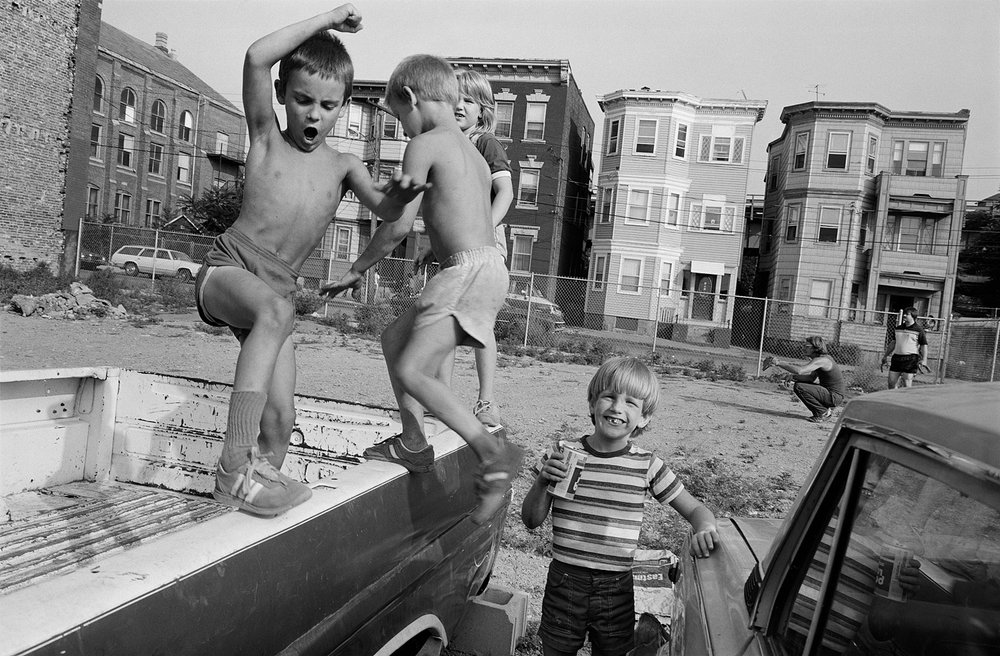
Four boys turn two parked trucks into a stage. In Sage Sohier’s photograph made in Chelsea, Massachusetts, in 1983, one boy balances on a tailgate with a fist lifted above his head and his mouth open. Another pivots toward him. A third stands between the vehicles and meets the camera with a grin. The fourth is partly concealed behind the action.
The picture is crowded but not chaotic. Arms, legs and glances move across the frame while the trucks hold the group together. Apartment buildings, a chain-link fence and a few distant figures extend the scene beyond the children. No single face explains what is happening. The event exists between them.
That is the central intelligence of Sohier’s work. Her photographs do not simply celebrate “human connection.” They show how relation becomes visible through bodies that coordinate and compete, rooms that stage belonging, objects that carry roles and performances made with the photographer. Her strongest pictures treat intimacy as social choreography rather than private essence.
Choreography does not mean that every scene is scripted. It means that a shared life has a form. People touch or keep their distance. They occupy the center or yield it. They arrange a home, perform a family role, care for an animal or turn a parked truck into a playground. Sohier’s photographs matter because they make those arrangements visible without proving that the camera has discovered everything they mean.
I. The Group Is the Event
The photographs now collected in Passing Time (opens in a new tab) were made from 1979 to 1985. Sohier found many of them decades later while revisiting negatives and contact sheets during the pandemic. They belong to a period when children and adults spent more time outside, but nostalgia is not their most interesting quality. What distinguishes them is the way a street, yard or porch becomes a temporary theater.
In describing the early work, Sohier has emphasized meeting strangers and collaborating until a compelling picture emerged (opens in a new tab). That account is more exact than the familiar language of invisible observation. The situation may begin without the photographer, but the photograph is made through proximity, attention and response. People notice the camera, continue what they are doing, intensify a gesture or invent another possibility.
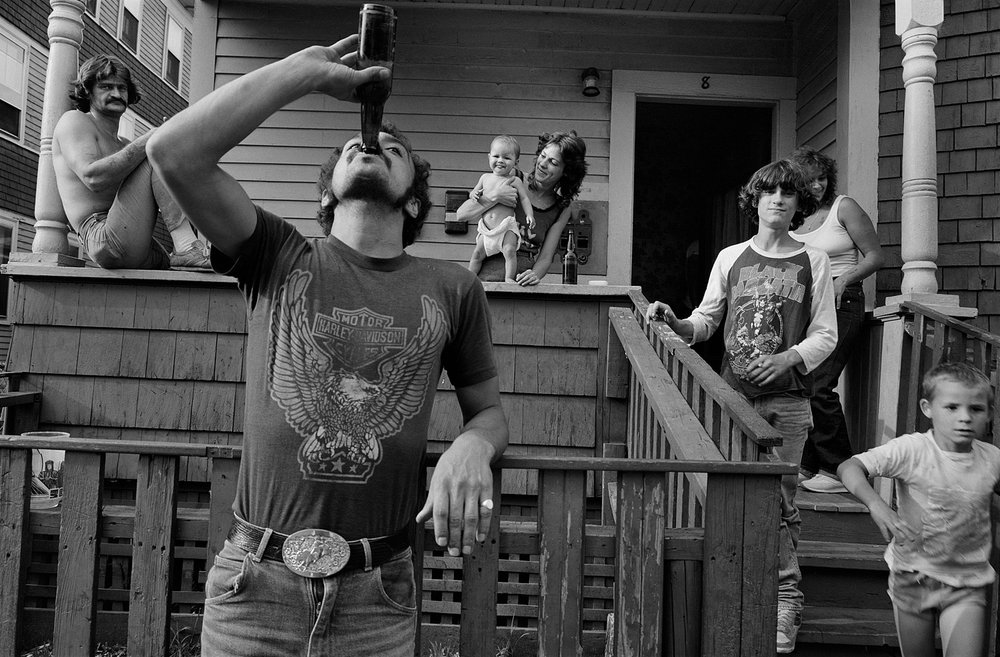
In the Worcester photograph above, a man drinking from a bottle occupies the foreground, but he does not own the scene. A shirtless man watches from the porch. A woman holds a baby. A teenager stands on the steps while another adult and a small child move at the right edge. Porch posts, railings and doorways divide the group without isolating it. The picture is less a portrait of one man than a map of who is present to whom.
Americans Seen (opens in a new tab) does not document the same people over several decades. Its photographs were made from 1979 to 1986. Its achievement lies elsewhere: Sohier recognized that a social world can appear in a fraction of a second when several lives share the frame.
II. A Private Life Becomes Public
At Home With Themselves (opens in a new tab) changes the meaning of space. Made mainly from 1986 to 1988, the project portrays same-sex couples in their homes during the AIDS crisis. Its domestic interiors answer public images of gay life organized around illness, danger and death. A bedroom, sofa or kitchen is not incidental background. Domestic space becomes evidence that relationships already possess histories, routines and material worlds.
The photograph of Gordon and Jim with Gordon’s mother Margot makes that political work especially clear. Sohier later explained (opens in a new tab) that the men had been together for 21 years and had recently come out to Margot after years of living beside Gordon’s parents. The picture was made two weeks later. Familiarity and discomfort occupy the same room. The photograph does not illustrate acceptance as a completed moral lesson. It records a family reorganizing what can be acknowledged.
It is tempting to call these portraits “normalizing,” but that word makes heterosexual domestic life the standard against which the couples must be approved. Sohier’s project is stronger than that. The pictures show different ages, classes, family structures, styles of touch and degrees of self-presentation. Some couples include children or parents. Some lean together while others maintain a careful distance. The work argues for visibility through difference, not sameness.
The domestic setting also complicates the idea that the camera simply reveals private truth. A home is both lived space and chosen setting. The people pictured decide where to stand, what to wear, what to display and how to appear together. Sohier decides where the frame begins and ends. The relationship becomes publicly legible through that negotiation.
The extensive interviews that accompanied the project (opens in a new tab) matter for the same reason. A photograph can show posture and proximity, but it cannot tell us by itself how a couple describes its history. The participants’ words resist the fantasy that looking is equivalent to knowing.
III. Intimacy Does Not Produce Neutrality
In Witness to Beauty (opens in a new tab), Sohier’s position inside the relationship becomes impossible to ignore. The principal sequence runs from 1994 to 2014 and centers on her mother, Wendy Morgan, a former fashion model. Beauty is not merely a physical trait in these photographs. It is labor, ritual, inheritance and a family role that mother and daughters continue to perform.
Sohier sometimes enters the frame. In one photograph, her mother and sister apply makeup to her. The photographer becomes a participant in the very system she is examining. She has described her role in the project as a foil, someone whose presence intensifies the contrast with her mother’s cultivated glamour. Looking is powerful here precisely because it is not neutral.
The project’s official book page (opens in a new tab) describes photographs made “of and with” Morgan. That small preposition is important. Morgan is subject, collaborator and performer. She brings a lifetime of experience before cameras, mirrors and audiences. Sohier records that performance, but she also prompts, selects and sequences it. The photographs carry affection and rivalry, admiration and analysis, because the family relationship cannot be separated from the act of making them.
This is a more useful model for documentary ethics than “objective observation.” Intimacy gives Sohier access, but it also increases her obligations. The photograph must answer to a person who exists after the session and who may not always want the same image made public. Ethical relation is not the absence of influence. It is the continuing negotiation of what that influence permits.
IV. Rooms Do Not Reveal; They Propose
Environmental detail does not unlock identity. In Sohier’s Perfectible Worlds (opens in a new tab), people build models, collect objects, restore artifacts, train animals and pursue elaborate forms of expertise. Their environments do not passively reveal who they are. They are worlds the subjects have already authored.
A man standing among miniature versions of North End businesses is not simply explained by his basement. The models translate memory and neighborhood history into a scale he can arrange. A woman beside dollhouse interiors has created rooms inside a room. The photograph encounters these acts of construction and adds another frame around them.
This distinction protects environmental portraiture from becoming visual diagnosis. A collection can easily turn its owner into an eccentric type. The successful photograph does not say, “This object explains this person.” It shows a person directing attention toward a world whose meanings exceed the frame.
Technique matters, but the visible evidence is enough. Sohier uses depth, spatial separation and detailed surroundings to keep subject and environment in active relation. We do not need an unsupported story about camera format or minimal manipulation to explain the result. The formal achievement lies in allowing the room to remain both evidence and proposition.
V. Care Is Not Innocent
Sohier’s photographs of people and animals extend social choreography beyond human speech. The earlier Animals (opens in a new tab) pictures and the later Peaceable Kingdom (opens in a new tab) include pets, working animals, rescues and wildlife sanctuaries. Touch, restraint, proximity and bodily dependence carry much of the meaning.
It is easy to reduce these pictures to “the special bond” between animals and humans. That language turns the animal into evidence of human tenderness. Sohier’s more complicated photographs show that care has a structure. One body feeds, houses, repairs or confines another. Affection can coexist with ownership. Rescue can require control. Dependency creates responsibility without making the relation equal.
The portrait of Ronnie with Luigi, a miniature donkey for whom he made a prosthetic leg, contains an extraordinary story of practical devotion. It also asks us to look at the apparatus of care, not only its emotion. The prosthetic, the human labor and the animal’s altered body all belong to the relationship.
This is where Sohier’s attention to arrangement becomes ethical rather than merely sentimental. The frame can show closeness while preserving evidence of asymmetry. It can recognize care without using the animal to certify the human subject’s goodness.
VI. Time Changes the Photograph
Time enters Sohier’s work in several distinct ways. Witness to Beauty develops through repeated family encounters over many years. At Home With Themselves includes 2002 revisits to two couples first photographed in the 1980s. Passing Time and Americans Seen, by contrast, gained new public lives when Sohier returned to an archive of photographs made decades earlier.
These are not interchangeable forms of duration. Returning to a person can register physical and relational change. Returning to a negative changes selection and sequence. The subject does not become older inside the original frame, but the culture looking at the picture does.
The delayed publication of At Home With Themselves makes that shift especially visible. Pictures made in the 1980s entered book form in 2014, after the terms of public recognition had changed. Their historical value does not replace their original political stakes. It reveals that a photograph’s meaning is partly made by when and where it circulates.
I return to the boys in Chelsea. We do not know their names, the rules of their game or what happened after Sohier left. The photograph gives us no private truth about their friendships. What it gives us is the visible form of a temporary world: challenge, imitation, performance, risk and delight distributed across four bodies.
That limit is not a failure. It is the source of the picture’s precision. Sohier’s best photographs do not convert relationships into lessons about universal connection. They show people making a world together while reminding us that the world remains theirs.
Gesture doing the work of intimacy is what Earworm collects.
Works Cited & Further Reading
Artist project records and interviews supporting the essay’s chronology and account of collaboration, domestic visibility and social choreography.
- Sohier, Sage. Passing Time (opens in a new tab).
- Sohier, Sage. Americans Seen (opens in a new tab).
- Sohier, Sage. At Home With Themselves (opens in a new tab).
- Sohier, Sage. At Home With Themselves: Interviews (opens in a new tab).
- Sohier, Sage. Witness to Beauty (opens in a new tab).
- Sohier, Sage. Witness to Beauty book page (opens in a new tab).
- Sohier, Sage. Perfectible Worlds (opens in a new tab).
- Sohier, Sage. Animals (opens in a new tab).
- Sohier, Sage. Peaceable Kingdom (opens in a new tab).
- The Guardian. “The Big Picture: Sage Sohier’s Passing Time” (opens in a new tab). 2024.
- The Guardian. Sage Sohier on Gordon, Jim and Margot (opens in a new tab). 2025.