Henri Cartier-Bresson and the Myth of the Decisive Moment
Cartier-Bresson’s photographs do more than stop time. They use geometry to make chance look inevitable, even as history and uncertainty remain outside the frame.
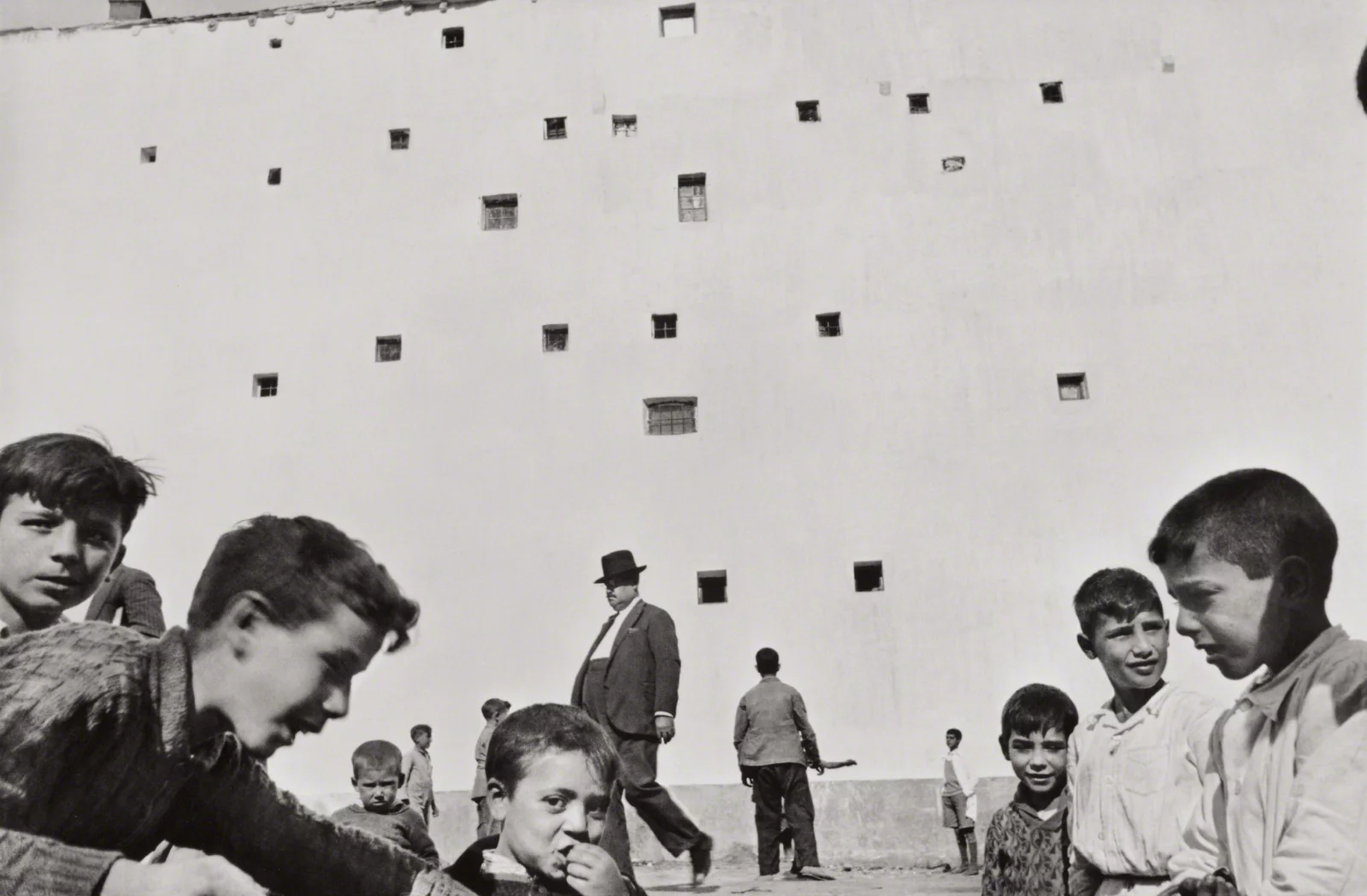
In Henri Cartier-Bresson’s Madrid, Spain (1933) (opens in a new tab), boys crowd the lower edges of a nearly empty courtyard. One bends over an activity outside the frame. Another looks directly toward the camera. A suited man crosses the open center while a second adult walks away. Above them, small windows puncture a blank wall like scattered notes.
No action commands the scene. There is no jump, embrace or raised fist that could be called its climax. The man at center is only walking. Yet the photograph feels complete. Bodies, windows and empty wall settle into an arrangement that seems both accidental and inevitable.
Read through the phrase “the decisive moment,” this authority becomes a problem of timing: the photographer sees a fleeting truth and releases the shutter before it disappears. The formulation makes photographic greatness sound like instinct perfected. It is also too simple. Reality did not arrive already framed, and timing alone did not turn these people into a coherent picture.
Cartier-Bresson’s photographs do not capture self-contained moments of truth. They make contingent events feel inevitable by bringing chance, geometry and intuition into temporary alignment. The result is decisive in form but unresolved in meaning. Subjects, memories and political histories exceed the instant that organizes them.
I. A Moment Without a Climax
Read as an instruction, the phrase “the decisive moment” compresses Cartier-Bresson’s practice into three commands. Wait. Watch. Press the shutter when action and composition peak together. The formulation then performs two jobs: it describes his work and offers a standard for judging photographic timing.
Publication history complicates the slogan. In October 1952 Verve published Images à la Sauvette (opens in a new tab) in a French-American co-edition initiated by Tériade, with a cover by Henri Matisse. Simon & Schuster chose The Decisive Moment for the American edition. The Fondation Henri Cartier-Bresson notes that the American title, rather than the French one, imposed the phrase as a shorthand for the work. A publishing decision helped turn a body of photographs into a doctrine.
Cartier-Bresson’s own definition was never only about speed (opens in a new tab). He described photography as the simultaneous recognition of an event’s significance and the rigorous organization of forms that express it. Event and form are inseparable. A gesture without structure is merely arrested motion. Structure without a living event is a design exercise.
Madrid exposes what the simplified version leaves out. The picture has no single event whose significance is self-evident. Its power depends on relations: the large man and small boys, the crowded foreground and spare center, the scattered bodies below and scattered windows above. The photograph does not simply preserve an instant. It gives the instant an internal order.
That order is not neutral. The frame cuts through bodies at both edges. It turns the wall into a field and the people into points of emphasis within it. The suited man occupies the clearest space, but the boys generate most of the visual pressure. Cartier-Bresson recognized a configuration in the world, then made it legible through exclusion.
Under this reading, the decisive moment is not the instant when reality confesses its meaning. It is the instant when a photographer’s choices make one arrangement of reality appear necessary.
II. Chance Learns Geometry
Cartier-Bresson did not acquire this order by memorizing a photographic formula. The Fondation’s chronology (opens in a new tab) records that he studied painting with André Lhote in 1926 and took his first photographs that year. Drawing, painting and photography belonged to the same long education of the eye. Geometry was not a grid applied after the fact but a way of recognizing relations inside the frame.
Buying a Leica in 1931–32 gave that cultivated perception mobility. Its importance was not that a small camera made him invisible. It allowed him to respond before a scene hardened into performance. He could move, wait and frame without the ceremony of a large apparatus.
Yet geometry describes only half of the practice. Cartier-Bresson’s early contact with Surrealism (opens in a new tab) encouraged attention to chance, visual shock and associations that rational intention could not fully plan. The street offered unstable conjunctions: a gesture rhyming with a painted figure, a face appearing between architectural forms, a child’s movement disrupting an adult space.
Contingency makes the popular language of mastery misleading. Cartier-Bresson mastered the conditions of attention, not the event itself. He could choose where to stand and when to release the shutter. He could not command a passerby to repeat a stride or make unrelated shapes suddenly echo one another.
Chance supplies more than raw material. It keeps the picture from becoming an illustration of a prior idea. Geometry then prevents chance from remaining noise. The photograph succeeds through their tension: receptivity without passivity, control without total control.
To call this intuition does not mean it is mysterious. Intuition is trained knowledge acting faster than conscious explanation. Cartier-Bresson’s speed mattered because years of looking had made complex spatial decisions available in an instant.
III. The Famous Puddle and the Myth of Reflex
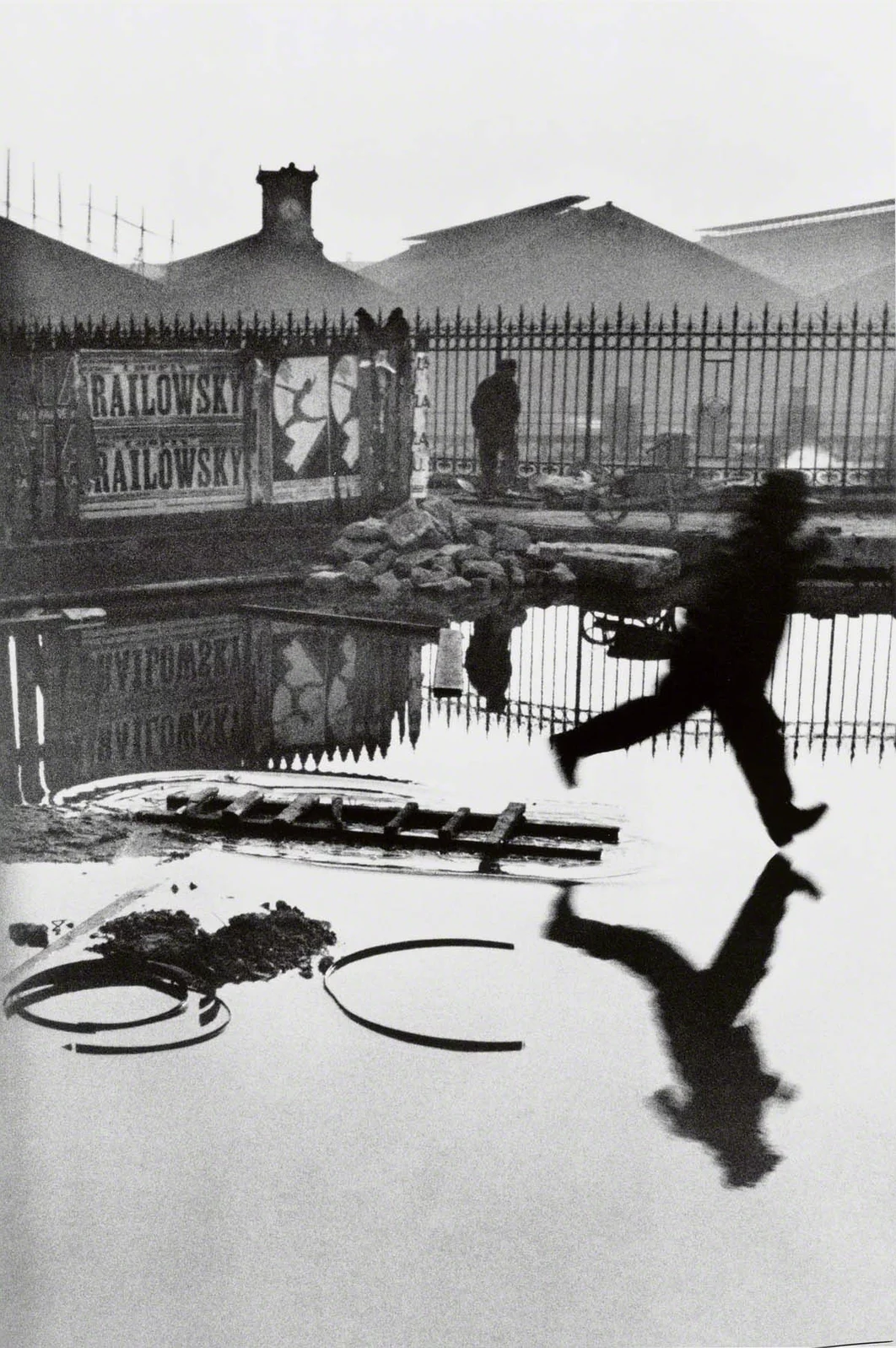
Behind the Gare Saint-Lazare (1932) (opens in a new tab) seems to prove the legend. A man clears the surface of a flooded construction site. His heel has not yet touched the water. A fraction later, the reflection would break and the clean interval between body and ground would vanish.
But the leap is only the most obvious event. The man’s dark reflection doubles his body. A figure on a circus poster beyond the fence appears to jump in a similar pose. Circular hoops in the foreground answer the expanding arcs of the legs. Fence posts, buildings and their reflections divide the picture into repeated vertical bands.
Timing secures the suspended heel. Geometry creates the photograph’s strange inevitability. The picture convinces us because a single body appears to activate a network of shapes that existed before he entered and would remain after he left.
My own pleasure in the photograph depends on that closure. I enjoy how the heel, reflection, poster and hoops resolve into one system, and that pleasure tempts me to treat elegance as evidence that Cartier-Bresson found the right instant. The picture’s order is real. My desire to convert that order into mastery is part of the myth.
Material conditions were less sovereign than the myth suggests. A Museum of Modern Art account (opens in a new tab) records that Cartier-Bresson wedged his camera into a narrow gap in a fence. Restriction helped produce the image. The barrier limited his position while the opening determined what the camera could see.
Calling the achievement contingent does not diminish it. It clarifies it. The photograph is not proof that a master can control contingency. It shows how alertness, limitation and luck can briefly converge. Cartier-Bresson did not manufacture the leap, poster or water. He recognized that the frame could make them answer one another.
Inevitability appears only after the photograph has removed every competing instant.
IV. The Surface Is Not a Soul
Perfect timing easily becomes a mythology of perfect access. A photograph can preserve the exact shape of a face, posture or gesture, then tempt the viewer to treat that surface as evidence of emotion, character or inner life. The image may support an interpretation. It cannot verify the private state it appears to reveal.
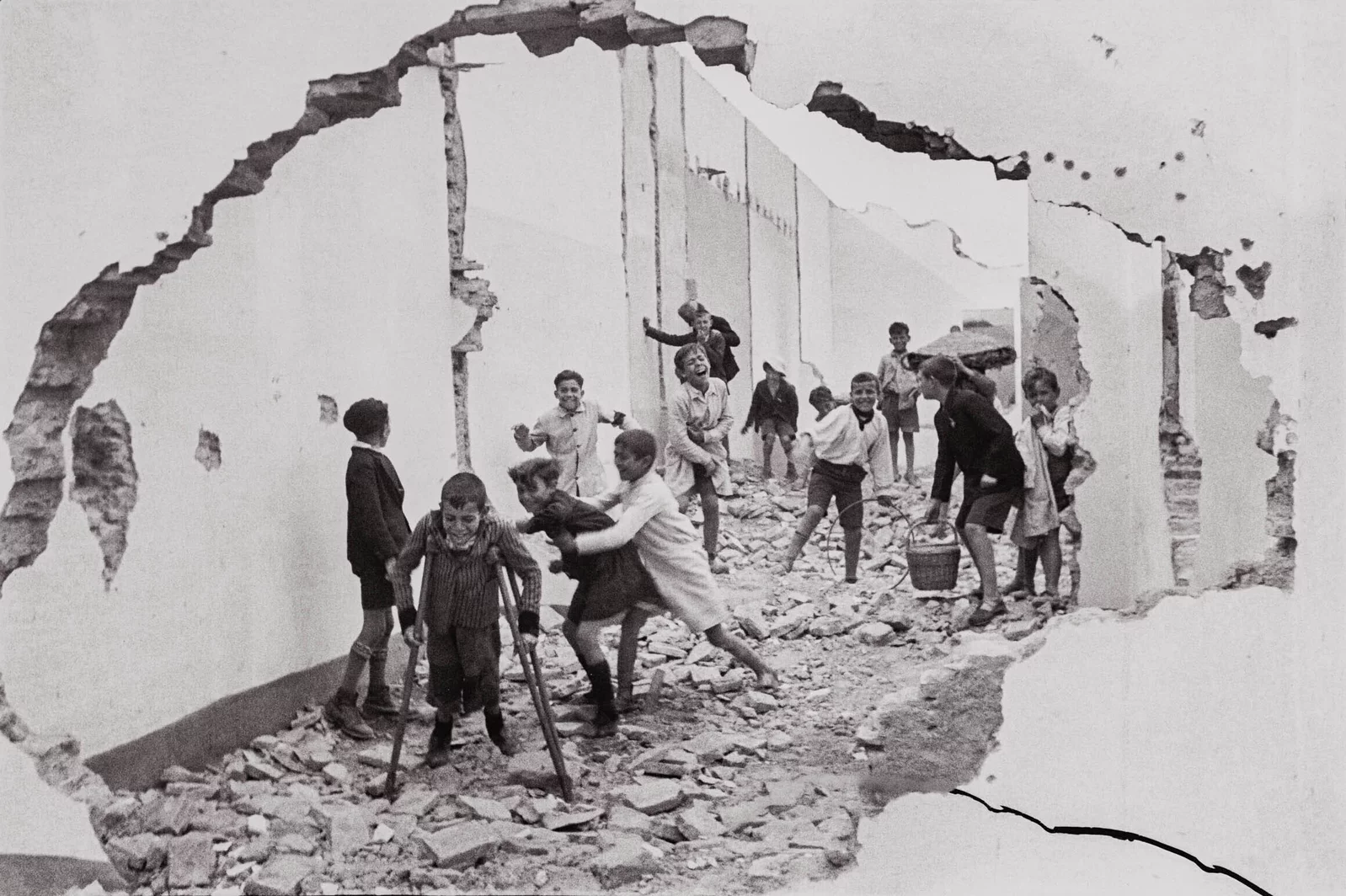
In Seville, Spain (1933) (opens in a new tab), boys play among rubble inside a ruined structure. A jagged opening in the nearest wall frames another broken room beyond it. One boy stands on crutches. Others run, push, watch or turn toward the camera. Their movements pull in different directions.
To call the picture a celebration of resilience makes the ruin serve as a moral test the children triumphantly pass. It converts observed play into an uplifting message for the viewer. The photograph shows activity, damaged architecture and a range of responses to the camera. It does not tell us how the children understand their surroundings or what they feel about them.
Cartier-Bresson’s humanism remains worth defending here. The boys are neither background nor sociological example; their movements organize the frame. But humanism becomes an alibi when “universal humanity” replaces social and political specificity.
Gesture is evidence of appearance, not a transparent window into character. A turned head, clasped hand or running body can organize a photograph and prompt an interpretation. It cannot establish an inner truth. The distinction matters because the camera’s seeming intimacy can make speculation feel like knowledge.
Seville’s ethical strength lies in its refusal to settle. Play and damage occupy the same space. The boys are neither abstract victims nor symbols of hope. They remain particular people whose lives exceed the meanings the frame makes available.
V. History Refuses the Single Frame
The isolated instant reaches its limits in Cartier-Bresson’s 1948 photographs of Mahatma Gandhi and the aftermath of his assassination (opens in a new tab). He photographed Gandhi at Birla House the day before the killing on January 30. He then recorded the body, mourners, funeral, cremation and the transport of the ashes.
To read this sequence chiefly as evidence that Cartier-Bresson understood cultural ritual is to remove the crisis that gives the pictures their force: Indian independence, Partition, religious violence, Gandhi’s hunger strike and an assassination that changed the meaning of photographs made only a day earlier.
No single exposure contains that history. A portrait of Gandhi before the assassination becomes charged by information the photograph could not yet possess. A crowd waiting for the funeral cortege gains meaning through its relation to the death, the political moment and the other photographs in the sequence.
Sequence produces a revealing tension. Cartier-Bresson resisted being called a storyteller, yet the Gandhi photographs become intelligible through sequence, caption and historical relation. The camera arrests instants. Editors and viewers place those instants into time.
Decisiveness is not sealed at the shutter. Later events can alter what an earlier picture means. A photograph may be formally complete while remaining historically unfinished.
That distinction protects the work from empty universalism. The mourners are not illustrations of grief in general. They are people responding to a particular death within a particular struggle over nation, religion and political power.
VI. What Photographers Should Inherit
Cartier-Bresson’s legacy should not be reduced to hunting for peak action. The useful inheritance is a way of preparing attention. Study form until geometry becomes responsive rather than diagrammatic. Move lightly enough to encounter what cannot be staged. Wait without pretending that patience makes the photographer invisible or neutral.
Every frame takes a position. It turns a continuous world into an arrangement with edges, emphasis and hierarchy. Recognizing that construction does not make the photograph false. It makes the photographer accountable for how contingency has been organized.
Practice also requires interpretive restraint. Describe the gesture before claiming the emotion. Name the historical conditions before invoking universal humanity. Ask what a sequence changes before treating one frame as sufficient. Do not confuse an elegant composition with a complete explanation.
Return to Madrid. The windows remain scattered. The boys still press against the edges. The suited man is forever crossing the center. Cartier-Bresson’s timing gives their relation a durable form, but it does not tell us who the boys are, what the man is thinking or what happened after he left the frame.
Formal decision cannot close the historical remainder, and that gap keeps the photograph alive. Its form decides where we look without deciding everything we can know. The frame decides. The world does not.
The waiting is the same in Synchronicity, but what I’m waiting for is a motif repeating rather than a shape resolving.
Works Cited & Further Reading
Artwork, publication and historical records supporting the essay’s account of geometry, contingency, sequence and the decisive-moment myth.
- Fondation Henri Cartier-Bresson. Images à la Sauvette: publication and exhibition history (opens in a new tab).
- Fondation Henri Cartier-Bresson. Henri Cartier-Bresson: life, work and archive (opens in a new tab).
- Fondation Henri Cartier-Bresson. Henri Cartier-Bresson biography and chronology (opens in a new tab).
- Fondation Henri Cartier-Bresson. Henri Cartier-Bresson, France 1926–1938 (opens in a new tab).
- Magnum Photos. Henri Cartier-Bresson’s photographs of Gandhi and the aftermath of his assassination (opens in a new tab).
- Magnum Photos. Madrid and Seville, Spain, 1933 (opens in a new tab).
- Museum of Modern Art. Henri Cartier-Bresson, Behind the Gare Saint-Lazare, Paris, 1932 (opens in a new tab).
- Museum of Modern Art. Henri Cartier-Bresson: The Early Work (opens in a new tab).