Cindy Sherman’s Deepfake Ghost: Performing Identity
Cindy Sherman’s staged photographs expose identity as a constructed performance, a condition intensified by social media, filters and deepfakes.
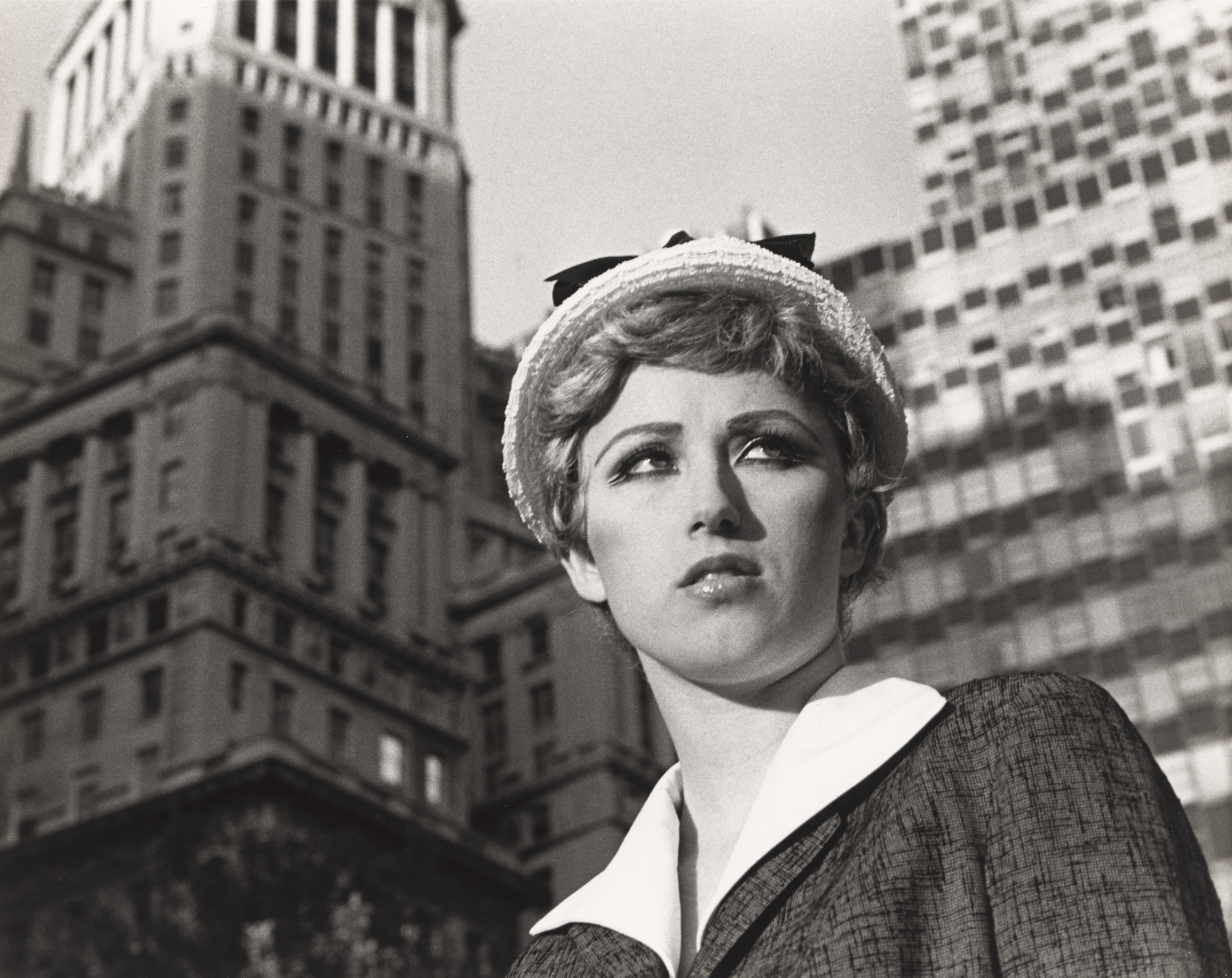
In Untitled Film Still #21 (1978), a young woman stands among the vertical facades of Manhattan, dressed like the ambitious newcomer in a midcentury film. She looks beyond the camera, alert to something outside the frame. The low viewpoint enlarges the buildings around her and gives the city the force of a second character. She might have just arrived. She might be deciding whether to leave. The photograph refuses to tell us.
There is no movie behind this image. There is no scene before it and no resolution after it. Yet the picture feels remembered. We recognize the career girl, the city and the suspended narrative because cinema has already taught us how to read them.
That false memory is the engine of Cindy Sherman’s Untitled Film Stills (opens in a new tab) (1977–80). Sherman did not reconstruct particular films. She produced photographs that appear to have escaped from films that never existed. Each image points sideways to other images, and those images point to still others. The original remains absent, but recognition survives.
Sherman’s deeper achievement was to show that the visible self arrives already entangled with pictures. Before we present ourselves to the world, culture has supplied a repertoire of poses, gestures and types through which a person can become recognizable. Social platforms did not invent that condition. They turned it into infrastructure.
I. The Image Arrives First
Although Sherman appears in every Untitled Film Still, the photographs are not conventional self-portraits. Her body is the material, but Cindy Sherman is not their subject in any confessional sense. She withholds the promise that a portrait will reveal an authentic personality behind the face.
Instead, she gives us types. The ingénue, the working woman, the vamp, the lonely housewife and the woman waiting for something just beyond the frame all seem to precede the individual performing them. Costume matters, but so do posture, lighting, camera angle and the direction of the gaze. A turned shoulder can suggest caution. A glance off-frame can create an unseen pursuer, lover or threat. A kitchen, hotel room or city street can place the figure inside a story that the photograph never has to provide.
These roles are not neutral. They come from an image culture in which femininity has repeatedly been organized for looking. Laura Mulvey’s account of Sherman and the female body (opens in a new tab) is useful because it describes more than the intentions of an individual male viewer. It names a viewing position built into visual culture, where the woman is made visible as spectacle while action and looking are aligned elsewhere.
Sherman occupies both sides of that structure. She is the photographed woman, but she is also the artist constructing the scene. That double position gives the work its charge, but it does not resolve its politics. Her authorship does not automatically liberate the figures she performs. The same image can expose a stereotype and repeat its visual pleasure. Sherman’s photographs remain alive because they refuse to tell us that appropriation is innocent or that parody always escapes what it imitates.
Judith Butler’s theory of gender performativity (opens in a new tab) gives us another way to understand what is happening. Gender, in this account, is not an inner truth expressed by repeated acts. The repetition helps produce the appearance of a stable identity in the first place. Sherman’s wigs and costumes can make this visible, but her work should not be reduced to the idea that identity is a wardrobe freely chosen by an autonomous person. The available roles already carry histories, permissions and penalties. Performance happens under constraint.
Jean Baudrillard’s account of the simulacrum (opens in a new tab) helps explain a different part of the problem. The Film Stills resemble copies, but no original film secures their meaning. They derive their authority from a field of other images. The simulacrum here is not proof that nothing is real. The body, the gendered conventions and their social effects are real enough. What disappears is the stable origin that would allow representation to be measured against a single authentic source.
II. Who Gets to Look
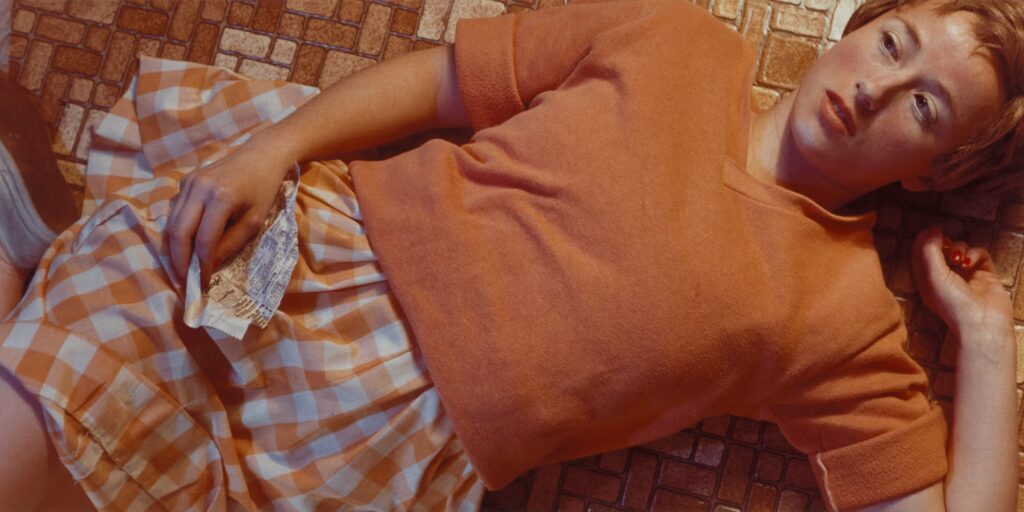
In 1981, Sherman turned from the compressed narratives of the Film Stills to the horizontal format of magazine centerfolds. Untitled #96 (opens in a new tab) places a young woman on a harvest-gold floor, her orange clothing pressed into the domestic color around her. She holds a personal ad clipped from a newspaper while looking away from us, absorbed in a private train of thought.
The shape of the photograph promises a pinup. The image refuses to deliver one. There is no nudity and no direct invitation to desire. Instead, the camera looks down. The figure lies beneath the viewer’s position, psychologically distant but physically exposed. She can appear dreamy, lonely, anxious or simply elsewhere. None of those readings settles the image.
That ambiguity matters because the Centerfolds do not stand outside the visual system they examine. They use the scale, format and vulnerability associated with erotic magazines while interrupting the gratification those conventions promise. The viewer is made aware of looking, but not released from it. Attraction, concern, surveillance and voyeurism remain difficult to separate.
This is where Sherman’s work becomes more demanding than the proposition that identity is constructed. The question is not only how a persona is made. It is who controls the scene, who receives permission to look and what power follows from being legible as a particular kind of woman.
The controversy surrounding the Centerfolds was therefore not incidental. Some viewers saw victimization in the reclining figures. Others saw a deliberate exposure of the visual habits that made vulnerability available as spectacle. Sherman does not resolve the disagreement because the viewer’s position is part of the work. Meaning is not contained entirely inside the photograph. It is produced in the encounter between the image and the person looking.
III. When the Illusion Begins to Fail
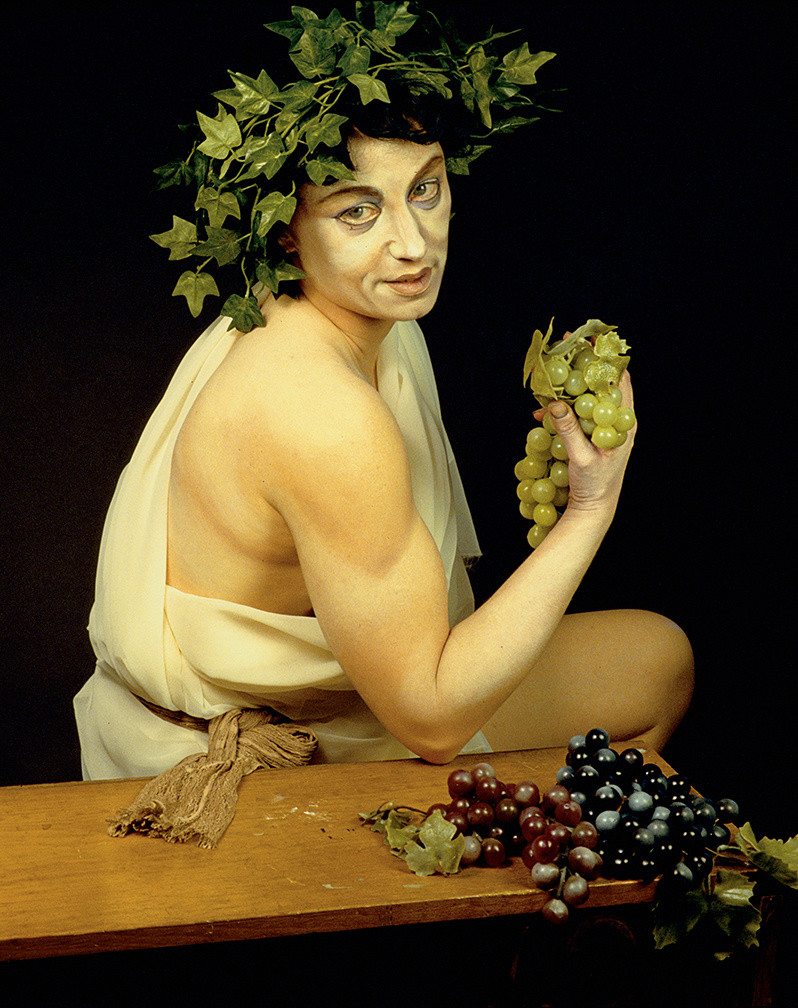
By the time Sherman made the History Portraits from 1988 to 1990, disguise had become more extravagant and its failures more visible. In Untitled #224 (opens in a new tab) (1990), she restages Caravaggio’s Sick Bacchus. A female artist performs a male artist performing the Roman god of wine. The layers of impersonation accumulate until the idea of an original identity becomes almost comic.
The resemblance is close enough to register, but the photograph never becomes a seamless copy. Makeup, costume and prosthetic transformation remain perceptible. Sherman does not conceal the labor required to manufacture authority. She brings the theatrical machinery of portraiture to the surface.
The joke is directed at more than the sitter. Old Master portraiture also constructed bodies through pose, costume, studio convention and symbols of status. Its claims to dignity and permanence were no less staged because their codes became culturally authoritative. Sherman’s deliberately imperfect transformations make that authority look strange again.
The sequence from the Film Stills to the Centerfolds and History Portraits therefore does not move from falsity toward truth. It moves through different regimes of belief. The Film Stills borrow the plausibility of cinema. The Centerfolds interrupt the promise of erotic access. The History Portraits expose the artifices through which institutions turn style into cultural legitimacy.
IV. From Role to Template
The contemporary platform persona belongs to this history, but it changes the conditions under which performance occurs. Instagram, TikTok and other visual platforms do not merely display identities. They sort, measure and reward them.
The clean girl, coquette, tradwife, fitness obsessive and dark-academia devotee are not complete people. They are templates made legible through recurring clothes, gestures, rooms, products, color palettes and fragments of narrative. Their recognizability makes them searchable and repeatable. It also makes them easy for platforms and advertisers to classify.
This does not mean the people performing them are dupes. Users can inhabit a type sincerely, ironically or both at once. A TikTok sketch that performs the “1990s sitcom mom” (opens in a new tab), for example, can expose a convention by exaggerating it. In that sense, vernacular parody can operate remarkably close to Sherman’s method. The joke works because a few gestures, vocal rhythms and costume cues can summon an entire media archetype.
The platform changes what happens next. Recognition becomes a metric. A performance that can be understood immediately is more likely to be watched, shared and reproduced. The algorithm does not need to know whether the persona is authentic. It needs the persona to generate a predictable pattern of attention.
This is what it means for identity to become algorithmically legible. The self is performed before an audience and tested against a system that returns views, likes, followers and commercial opportunities as feedback. The platform teaches users which versions of themselves circulate most efficiently.
Filters intensify that feedback. The altered face is no longer only an image presented to others. It can become the model against which the unfiltered body is judged. The copy returns to discipline its source.
V. Appearance Without Consent
Deepfakes push the separation between body and image into a more dangerous register. Their politics differ fundamentally from Sherman’s masquerades.
Sherman authors her transformations. She chooses the costume, controls the camera and decides which image will circulate. The distance between her body and the persona is the space of her artistic agency.
A deepfake can use another person’s face or voice to make them appear to perform an action they never undertook. The person has not vanished as a referent. Their recognizability is precisely what gives the fabrication its force. What has been removed is their participation in the performance. Consent to the fabrication’s production or circulation may also be absent.
That distinction matters. The deepfake ghost is not a person without an image. It is an appearance made to act after agency has been stripped away.
Synthetic media is not inherently abusive. It can be consensual, disclosed and creatively useful. The ethical breach occurs when likeness is treated as raw material while authorship, provenance and consent are hidden or ignored. The technology makes a long-standing politics of representation newly scalable. NIST’s guidance on synthetic-content risks (opens in a new tab) similarly centres provenance, disclosure and the consequences of deceptive media.
Sherman’s work cannot answer those questions for us, but it prevents an easy mistake. The problem did not begin when machines learned to generate faces. Image culture has long separated people from the roles through which they become visible. Generative systems automate that separation and make it possible to perform identity without the person whose identity is being performed.
VI. Construction Is Not the Opposite of Truth
As a photographer, I do not take construction to mean that photographs cannot tell the truth. It means that photographic truth cannot be separated from the encounter that produced the image, the decisions that shaped it or the conditions under which it circulates.
A portrait can disclose something real without revealing an untouched inner essence. A documentary image can bear witness without being neutral. A staged photograph can expose the social structures that candidness leaves invisible. Construction does not abolish truth. It makes responsibility for the truth impossible to evade.
Sherman’s relevance is not that she predicted a world in which nothing is real. It is that she showed how images teach us which selves are recognizable, desirable and available to inhabit. Platforms did not invent that process. They industrialized it. Deepfakes reveal its limit, where the image no longer waits for the person it claims to represent.
Sherman staged the performance. In Hair, people are doing it unprompted.
Works Cited & Further Reading
Sources supporting the essay’s account of staged identity, gendered looking, platform templates and synthetic media.
- Baudrillard, Jean. Simulacra and Simulation (opens in a new tab). Translated by Sheila Faria Glaser. University of Michigan Press, 1994.
- Butler, Judith. “Performative Acts and Gender Constitution” (opens in a new tab). Theatre Journal 40, no. 4 (1988): 519–531.
- Mulvey, Laura. “A Phantasmagoria of the Female Body: The Work of Cindy Sherman” (opens in a new tab). New Left Review I/188, 1991.
- Museum of Modern Art. Cindy Sherman, Untitled Film Still #21, 1978 (opens in a new tab).
- Museum of Modern Art. Essay on Cindy Sherman’s Untitled #96 (opens in a new tab).
- Museum of Modern Art. Audio record for Cindy Sherman’s Untitled #224 (opens in a new tab).
- National Institute of Standards and Technology. Reducing Risks Posed by Synthetic Content (opens in a new tab). NIST AI 100-4, 2024.
- Sherman, Cindy. “It Began with Madame de Pompadour” (opens in a new tab). Art21 interview.