Mary Ellen Mark: The Ethics of Seeing
Mary Ellen Mark built her documentary practice through encounters that were embedded, revisited or carefully staged. Her subjects look back, pose, speak and change, but intimacy does not erase the unequal power to select, publish and leave.
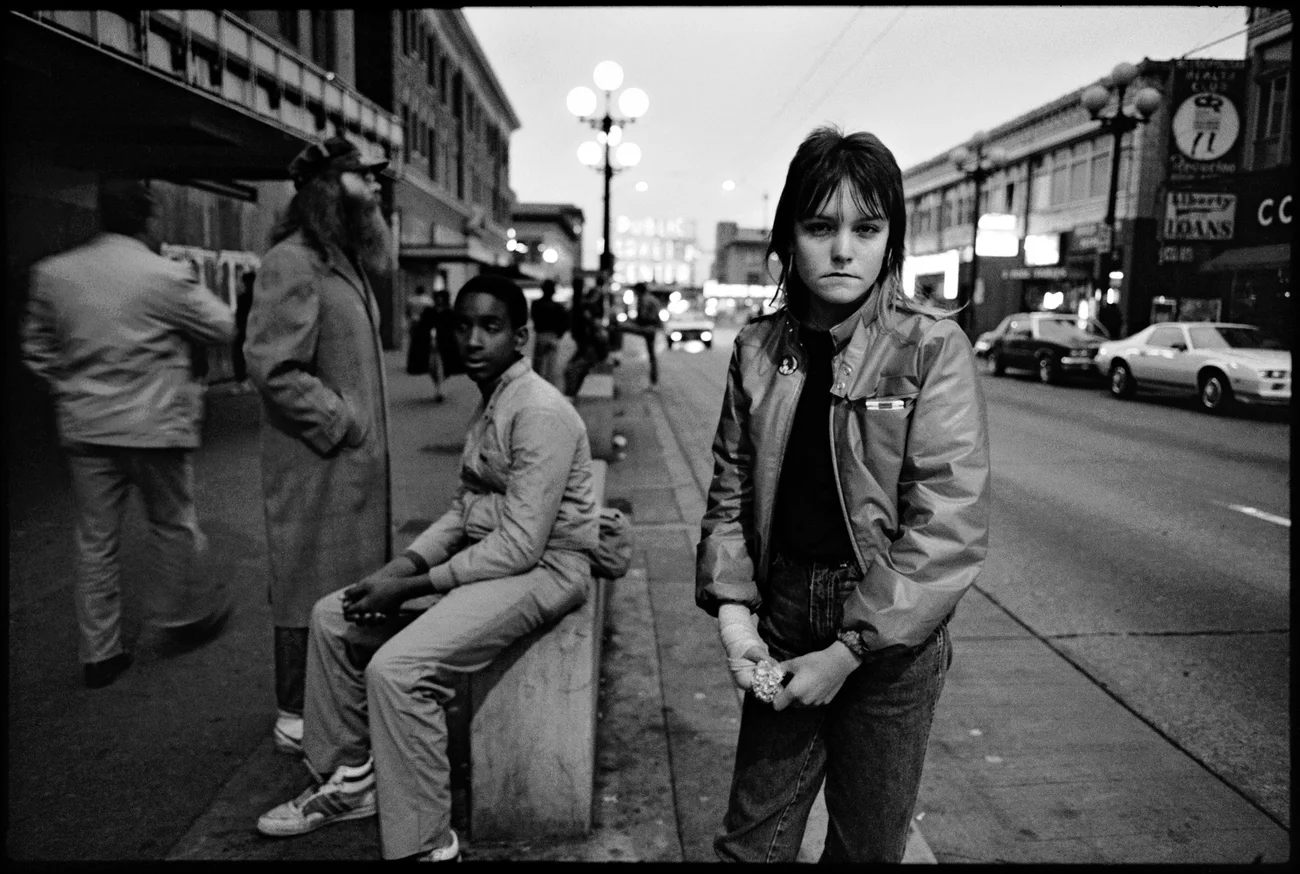
Erin “Tiny” Blackwell stands on Pike Street in Seattle in 1983. She is close enough to Mary Ellen Mark’s camera that the street seems to open behind her. A boy sits on a concrete block and turns toward the lens. Adults blur at the left edge. Cars, storefronts and streetlights recede into the distance. Tiny looks directly at Mark, her hands gathered at her waist, her expression guarded but composed.
The photograph feels intimate because Tiny does not appear caught or exposed. She appears to meet the camera. Mark’s nearness, the direct gaze and the history we now know followed this encounter all encourage us to read the image as recognition between two people. Yet recognition is not equality. Tiny could look back, speak, refuse and perform, but Mark still selected the frame, built the sequence and carried the photograph into magazines, films, books, galleries and history.
The tension between recognition and unequal control runs through Mark’s strongest work. She spent weeks inside a locked psychiatric ward, months in Bombay’s red-light district and decades returning to the same person. She also made brief, highly staged portraits. These are not one ethical method. What connects them is that the encounter itself becomes part of what the pictures ask us to see. Subjects look back, pose, speak, withhold and change across time.
Mark’s ethical significance lies in making the photographic encounter, whether embedded, revisited or staged, visible within the work. Her subjects gain expressive presence, but that presence does not become shared structural control. Selection, copyright and circulation remain concentrated with Mark and the institutions that publish and exhibit her photographs. The work matters because it holds recognition and appropriation in unresolved tension. Relation modifies documentary extraction without redeeming it.
I. Access Is Not Innocence
Mark first visited Oregon State Hospital in 1975 while photographing the production of One Flew Over the Cuckoo’s Nest. In 1976 she returned with writer and licensed therapist Karen Folger Jacobs. They spent 36 days living and working with the women of Ward 81, the hospital’s locked psychiatric ward for women. The photographs were made in 1976. The book Ward 81 (opens in a new tab) appeared in 1979.
The distinction matters because a book can compress a month of changing relations into a stable object. Mark and Jacobs ate, talked and waited with the women. They recorded interviews, made Polaroids and learned when the camera was welcome. The duration produced familiarity, but it also exposed the limit of any claim that they had shared the women’s condition. Mark and Jacobs could leave. The patients could not.
Mark understood that contradiction. In the later Ward 81 Voices archive (opens in a new tab), she described anyone who photographs people as an intruder. The archive also records that she and Jacobs discussed access, obtained institutional and family permissions, gave women Polaroids and sometimes invited them to pose or use recording equipment. Those acts altered the encounter. They made room for performance, speech and refusal inside a system organized around confinement.
They did not eliminate the system’s power or their own. Permission granted by a hospital or a relative is not identical to consent from a patient whose freedom and legal agency may already be restricted. A woman’s pleasure in being photographed does not settle how her image should later circulate. Collaboration at the moment of exposure does not automatically become control over editing, captioning or publication.
Mark’s method becomes ethically serious when the work makes its dependence on a relationship visible. Its value lies less in proving her goodness than in making the photograph visibly contingent on a relationship. The image is not simply taken from institutional life. It is produced through a difficult negotiation inside it.
II. The Color of Permission
Mark photographed on Falkland Road in Bombay in 1978 and 1979. The book Falkland Road: Prostitutes of Bombay (opens in a new tab) was published in 1981. Again, the photographic dates and publication date should not be collapsed. The project grew through repeated presence. In Mark’s later account of making the Falkland Road photographs (opens in a new tab), people initially threw garbage at her and stole her wallet. Access widened after one madam invited her in for tea and other establishments followed.
The story is often told as a moral conversion. Hostility becomes friendship, friendship becomes trust and trust becomes permission. That sequence is too neat. Access granted through a madam does not tell us what each worker wanted from the camera. Repetition can demonstrate commitment while also wearing down resistance. Friendship can be real without making the interests of photographer and subject identical.
The photographs intensify this ambiguity because they are sensuously colored. Blue walls, red fabric, painted faces and cramped interiors refuse the gray distance often associated with social documentary. Mark does not render the women as a uniform class of victims. The rooms have texture, style and theatrical force. The women look tired, amused, suspicious, distracted and self-possessed.
But color also attracts. It can turn a place structured by labor, poverty and sexual commerce into an exotic visual world for a Western audience. The magazine sponsoring the project required Mark to work in color, which reminds us that documentary form is never negotiated only between photographer and subject. Editors, commissioners, publishers and markets are present even when they remain outside the frame.
Falkland Road is ethically powerful because it does not resolve that conflict. Beauty does not cancel exploitation, and the existence of exploitation does not make beauty fraudulent. The pictures ask us to remain with both without converting the women into either spectacle or moral instruction.
III. When a Life Becomes a Project
The relationship with Tiny is the strongest test of Mark’s ethics because it lasted for more than 30 years. Mark met her in Seattle in 1983 while working with writer Cheryl McCall on a Life story about homeless and runaway teenagers. Tiny was 13 and surviving on the street. Mark’s photographs fed into the 1984 film Streetwise (opens in a new tab), directed by Martin Bell, and the 1988 book of the same name. Mark continued photographing Tiny through adulthood and motherhood. Their long relationship later became Tiny: Streetwise Revisited (opens in a new tab).
Duration distinguishes this work from the brief encounter that documentary photography often turns into permanent identity. Tiny is not frozen at 13. She grows older, has children, struggles with addiction, revises her memories and speaks about her life. The later work can correct the first image’s false finality. It insists that a person continues after the photograph that made her visible.
Yet return can create another form of claim. A life followed over decades becomes a photographer’s signature project. Intimacy becomes cultural value, professional distinction and an archive. The relationship may be genuine, but the resulting authorship remains uneven. Tiny gives the work its life. Mark’s name governs its place in photographic history.
Unequal authorship does not invalidate the photographs. It changes the question. The ethical issue is not whether Mark cared for Tiny. The record makes that care difficult to doubt. The issue is what care requires when another person’s hardship becomes central to one’s own work. Does the relationship give the subject greater ability to shape the account? Can she contest a caption, refuse a later use or redirect how the archive understands her? What does the work owe her beyond continued attention?
Duration is therefore not a certificate of virtue. It is an accumulation of obligations. The longer the relationship continues, the less plausible it becomes to treat the subject as material encountered once and owned forever.
IV. The Camera Does Not Make the Contract
Mark moved among cameras according to the encounter she wanted. A small Leica supported mobility and close observation. Medium and large formats slowed the exchange and made posing more explicit. Twins (opens in a new tab), made principally at festivals in 2001 and 2002, and Prom (opens in a new tab), made at 13 schools from 2006 through 2009, are useful counterexamples to the idea that ethical relation requires a long acquaintance. Their monumental Polaroid sittings were brief but openly produced. The camera’s scale announced the photograph before it was made, and the immediate print allowed subjects to see a result without waiting for an editor or laboratory.
These choices matter because equipment organizes behavior. A quiet handheld camera permits one kind of proximity. A large camera, lights and backdrop produce another. The first can make the photographer less conspicuous. The second can make the subject’s performance unmistakable. Neither arrangement is inherently more truthful or ethical.
The existing essay claims that immediate feedback collapses the hierarchy between photographer and sitter. It does not. Seeing a Polaroid is participation, not shared editorial control. A subject can recognize herself in the image and still have little authority over which frame is published, how it is captioned, what it earns or where it travels.
Mark’s technical intelligence deserves a more exact claim. Her cameras did not solve the power relation. They made different parts of it available for negotiation. The sitters contribute costume, gesture, pose and self-presentation. Mark still chooses whom to photograph, where the frame ends and how the pictures become a sequence. The ethical possibility lies in how the photographer responds to that visible co-production, not in the machine itself.
V. Recognition Can Become a Style
Mark’s photographs repeatedly find a charged meeting of vulnerability, performance and visual strangeness. For Indian Circus (opens in a new tab), published in 1993, she spent six months visiting 18 circuses. That figure describes the scope of the project, not necessarily the duration of her relationship with each performer. A long project can still be made from short encounters. In one photograph, a contortionist bends backward while a puppy sits beside her. The impossible body and ordinary affection occupy the same frame.
Mark was alert to contradiction, but contradiction can become a signature as recognizable as any lighting style. The child who appears older than her years, the performer seen between stage and private life, the person society calls marginal who meets the lens with composure. Repeated across a career, these encounters can make individuality visible. They can also sort different lives into the photographer’s preferred theater of resilience.
The production of marginality is why the familiar claim that Mark photographed “people on the margins” needs resistance. A margin is not a natural habitat. It is produced by institutions, economies and by the center that names itself normal. Documentary photography can expose that arrangement, but it can also preserve it by making marginality the subject’s defining attraction.
Mark’s best pictures exceed the category because the people in them do more than illustrate exclusion. They pose, withhold, perform, look back and sometimes appear indifferent to the story the photographer hopes to tell. Their opacity interrupts the humanitarian promise that the camera has made them fully knowable.
Recognition is therefore not the opposite of objectification. It is a practice that must remain open to what the image cannot explain. A subject’s dignity does not depend on the photographer discovering a heroic interior beneath difficult circumstances. It begins with the admission that the person in the frame cannot be exhausted by the photographer’s interpretation.
VI. What the Spectator Inherits
The ethics of these photographs does not belong to Mark alone. In The Civil Contract of Photography (opens in a new tab), Ariella Azoulay treats photography as a continuing relation rather than the sovereign act of one author. A picture connects the photographer, the photographed person, institutions, publishers and spectators. Those relations persist after the shutter closes and after the image changes owners.
That approach is useful because it neither canonizes nor cancels Mark. The people she pictured shaped the event through their looks, performances, refusals and continuing lives. This is expressive power. Mark, her editors, publishers and later custodians determined selection, copyright, captioning and reuse. This is structural power. A returned gaze is not shared ownership, but neither is the photographed person reducible to passive material. We enter the relation when we decide what kind of knowledge the image gives us and what claims we allow it to support.
Susie Linfield’s defense of looking supplies an equally important warning. Suspicion of exploitation can become an excuse for looking away from violence, poverty and institutional power. The answer to a compromised image is not automatic refusal. It is a more demanding form of attention, one capable of feeling without mistaking feeling for justice.
I return to Tiny on Pike Street. Her gaze gives the photograph its force, but it is not evidence that the terms were equal or that we now know her. It is an address. She appears within Mark’s frame while withholding whatever the frame cannot contain. The decades that followed make that limit clearer, not less important.
Mark’s ethics were strongest when duration made her answerable to what happened after the photograph. The relationships did not purify the images. They prevented the shutter from being the end of the encounter.
That is the responsibility her work passes on. We owe the photographed person more than admiration for the photographer’s empathy. We owe her attention as someone whose life exceeds the picture, whose claim on its meaning persists and whose visibility does not surrender her to us.
The subject returning the look is the whole subject of The Picture Looks Back.
Works Cited & Further Reading
Sources supporting the essay’s historical claims and its argument about intimacy, consent, authorship and spectatorship.
- Azoulay, Ariella. The Civil Contract of Photography. Translated by Rela Mazali and Ruvik Danieli. Zone Books, 2008.
- Aperture. “Tiny: Streetwise Revisited, Photographs by Mary Ellen Mark.” Exhibition record, 2016.
- Aperture. Twins by Mary Ellen Mark. Publication record.
- Criterion Collection. Streetwise / Tiny: The Life of Erin Blackwell.
- Mark, Mary Ellen. Falkland Road: Prostitutes of Bombay. Alfred A. Knopf, 1981.
- Mark, Mary Ellen. Indian Circus. Chronicle Books, 1993.
- Mary Ellen Mark Foundation. Project commentary on Falkland Road and Indian Circus.
- Mary Ellen Mark Foundation. Ward 81 Voices. Steidl, 2023.
- Philadelphia Museum of Art. “Prom: Photographs by Mary Ellen Mark.” Exhibition record, 2012.