Chris Killip and the Limits of Proximity
Chris Killip spent years returning to communities reshaped by industrial decline, sometimes living among the people he photographed. His photographs show what proximity can make visible, and why access never becomes possession.
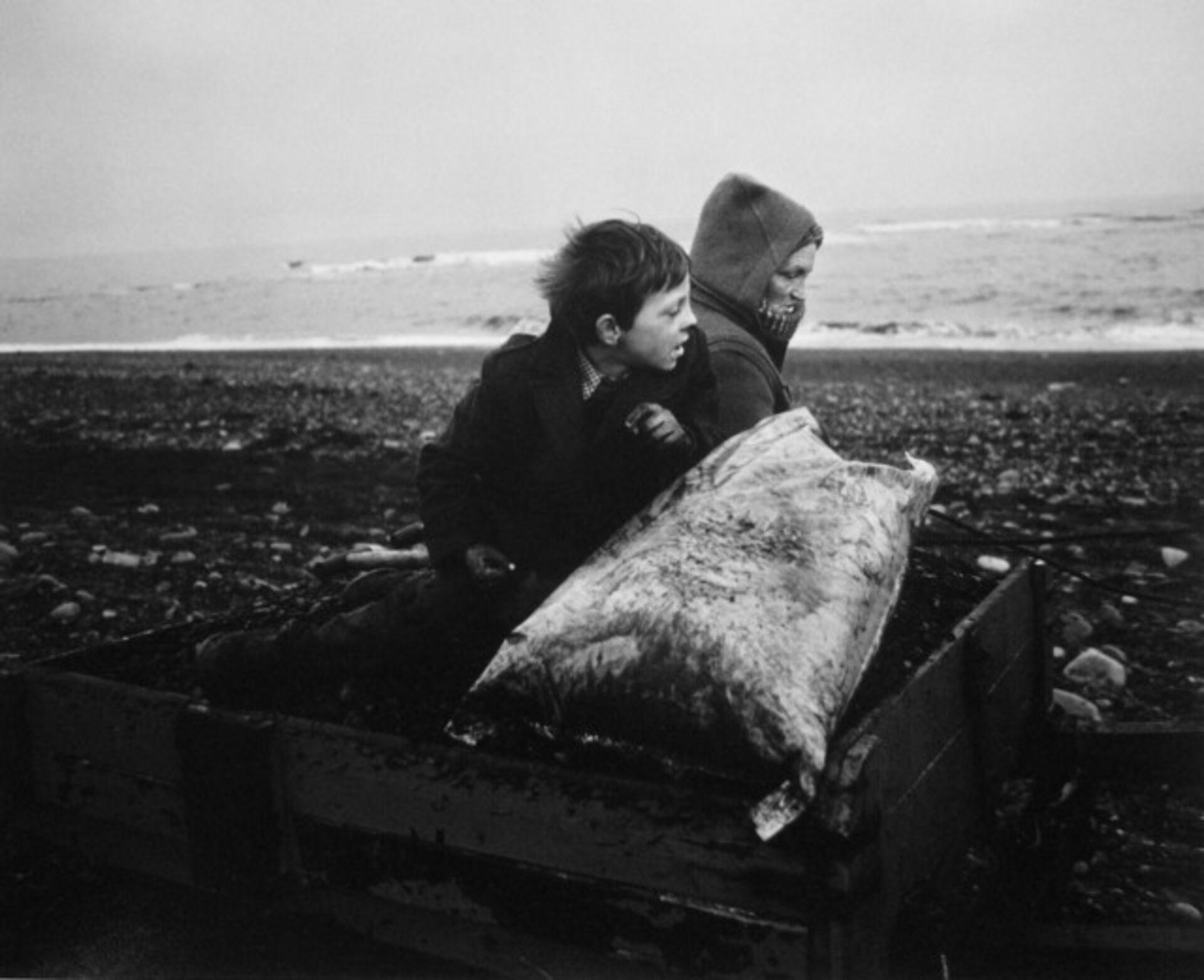
Rocker and Rosie sit on a rough cart at Seacoal Beach in Lynemouth, a large sack rising between them almost to their shoulders. The North Sea flattens into a pale band behind their heads. Rocker has turned toward something outside the frame. Rosie faces the other way, her hood pulled close around her face. They share the cart, the weather and the journey home, but the photograph does not turn them into a single expression of hardship.
Knowing where Chris Killip made the picture makes a social reading almost unavoidable. Lynemouth was a place where people recovered waste coal from the sea and shore, selling what they could gather from the residue of the industry around them. Killip first encountered the beach in 1976 and returned for years. Those conditions belong to the photograph, but they do not exhaust the meanings Rocker and Rosie can acquire within it.
Across Killip’s work, factories close, houses disappear, and coal, ships, unemployment and damaged landscapes press into view. The people inside those conditions do not settle so easily. They flirt, work, dress up, sulk, laugh, fight, wait, pose and look elsewhere. History constrains the field without supplying a final identity for anyone who appears inside it.
Killip’s method sharpens the contradiction. At Lynemouth he eventually bought a caravan and lived on the beach for more than a year. At Skinningrove he returned to a fishing village suspicious of outsiders carrying cameras. In Gateshead he spent Saturdays inside a punk venue run by the young people who used it. Proximity changed what he could see, but he never treated access as proof that the distance between photographer and subject had disappeared. In the foreword to In Flagrante (opens in a new tab), he described himself as “superfluous” to the people in his photographs and admitted to coveting lives that were not his.
Those admissions belong together. Killip wanted to get close, and he understood that wanting did not make the lives before him available for possession. His achievement was not becoming an insider. It was learning to work within a relation in which closeness mattered precisely because difference remained.
I. The Photographer Is Superfluous
In Flagrante, published in 1988 from photographs made in northern England between 1973 and 1985, is often read as an account of deindustrialisation. That reading gets the history right but risks making it the whole picture. Shipyards, coal mines, steelworks, housing clearances and unemployment are not background decoration. Killip watched an industrial region lose institutions around which work and communal life had been organised. Yet he resisted presenting the book as an objective history of that transformation.
His short foreword is unusually severe about the photographer’s authority. Killip calls the book subjective, warns that the photographs may disclose as much about him as about what they describe, and ends by calling the book a “fiction about metaphor.” Then comes the more difficult admission: he covets lives that are not his.
To covet is to want, not merely observe. The word does not settle Killip’s motives, but it places desire inside the documentary relation. He is drawn toward lives whose conditions he does not share. Access does not put an end to that desire. If anything, the repeated return suggests that closeness keeps opening onto something still beyond him.
Calling In Flagrante a fiction can sound like a retreat from documentary truth. It is better understood as an acknowledgment of authorship. The people existed. The places existed. The closures happened. Killip’s negatives retain contact with those events. But the book remains a selection made from particular positions and moments, then printed and sequenced into an argument. The history is real; the account has been made.
David Campany has noted (opens in a new tab) that photographs near the beginning and end of In Flagrante include the shadow of Killip and his bulky camera. A photographer who might conventionally disappear behind documentary authority leaves a trace of himself on the scene. The shadow does not equalize the relation between looking and being looked at. It makes the fiction of standing outside it harder to sustain.
Killip later described every photograph as evidential because it fixes a moment that cannot be recovered. He also described black-and-white photography as an abstraction, one step removed from reality and already associated with historical memory. Evidence and abstraction are not opposites here. A photograph can retain material contact with an event while transforming that contact through framing, tonal translation, selection and later use.
That is what keeps In Flagrante from becoming a social survey. The document needs interpretation to become an account, while interpretation remains answerable to what the camera encountered. Neither term can stand alone.
II. Getting Closer
Duration was central to Killip’s method. In a 2017 Getty interview (opens in a new tab), he recalled advice that six skilled visiting photographers could spend six weeks in Newcastle and produce broadly similar pictures. Stay six months, sixteen months or two years, he argued, and something else becomes possible. Familiarity weakens the fixed picture an outsider carries into a place. Ambiguity has time to enter.
Lynemouth became the clearest test of that proposition. When Killip first saw Seacoal Beach in 1976 (opens in a new tab), men were standing in the North Sea with wire nets, recovering coal from mine waste that had been dumped into the water and washed back onto shore. Horses and carts moved between an industrial twentieth century and a form of labour that seemed much older. Killip kept returning, though return was not the same as belonging.
The seacoalers also had practical reasons to be wary. Getty’s account of the project (opens in a new tab) notes that some were receiving unemployment benefits while earning money from recovered coal. A stranger with a camera could therefore carry consequences beyond photography. Visibility was not automatically benign.
Eventually, visiting itself became the limit Killip wanted to cross. He bought a caravan, moved onto the beach and stayed for more than a year. The caravan became a meeting place where people came for tea, conversation and photographs. Instead of appearing only at the instant of exposure, the camera entered an ongoing social exchange.
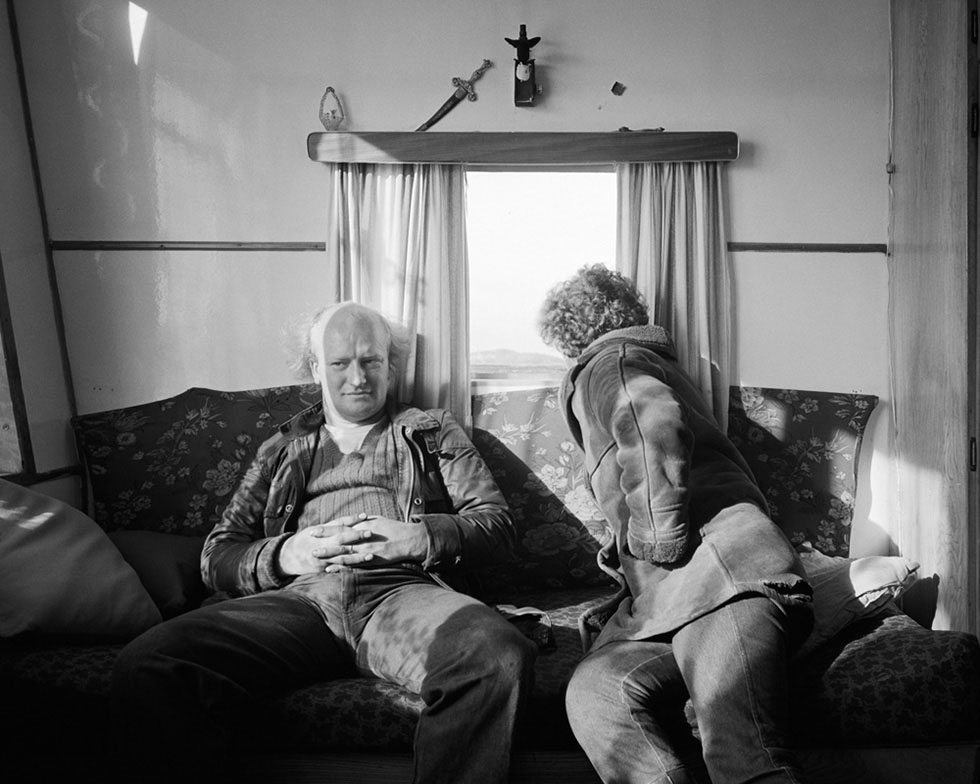
The easy story would be one of ethical progression: outsider becomes familiar, familiarity becomes intimacy, intimacy becomes authentic knowledge. Killip’s own position refuses the last step. He became closer to the people at Lynemouth without becoming someone whose life depended on the beach under the same terms.
Power remained uneven in more practical ways too. Killip could leave. He chose which negatives became prints, which prints entered books and exhibitions, and which moments would continue to represent Lynemouth decades later. Familiarity changed the relation without abolishing authorship or the unequal consequences of circulation.
Proximity gave him information, trust, humor and contradiction that distance might have missed. It also exposed how much remained outside what he could know. Each new layer of access answered some questions and produced others.
The limit, then, is not simply what remains when knowledge fails. It helps keep the desire to get closer in motion. Killip’s strongest photographs make the relation more particular without pretending that particularity ends in possession.
III. History Without Types
Consider Youth on a Wall, Jarrow, Tyneside. A boy folds himself into the corner of a brick structure, knees pulled upward, one hand pressed against his face. His jacket hangs loose around him. Heavy boots project toward the edge of the frame.
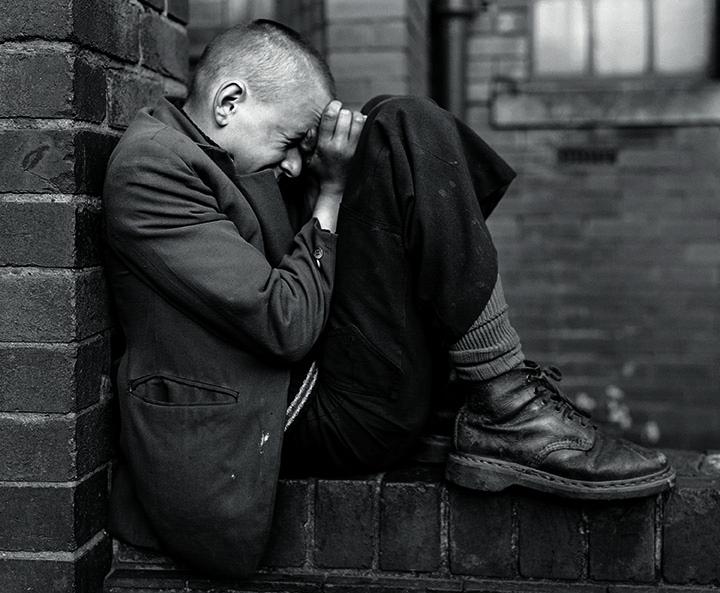
The pose invites psychology. Exhaustion, embarrassment, laughter, distress or an event outside the frame can all be imagined from it. But the problem is not merely that the photograph withholds the boy’s true feeling. A gesture does not necessarily translate a single stable inner state in the first place. Posture, self-consciousness, bodily habit, the camera’s presence and whatever has just happened may overlap without resolving into one explanation.
A weaker documentary reading closes that uncertainty by turning the boy into a symbol. He becomes “despair.” The wall becomes “decline.” A whole region is made to speak through a gesture whose immediate cause and psychic meaning remain unavailable.
Historical context gives the photograph real pressure without needing that invention. Jarrow and the wider Tyneside landscape were being transformed by the contraction of heavy industry. In his Getty interview, Killip recalled photographing the Swan Hunter shipyard obsessively because he knew its world would not last, although he did not grasp how rapidly the change would occur. A streetscape he photographed in 1975 was already being demolished by 1977.
The claims need to stay separate. The photograph shows the boy’s posture. The historical record can tell us something about the place around him. Neither authorizes a diagnosis of his interior life.
Documentary photography has often converted people into evidence for conditions that surround them. Poverty produces “the poor.” Unemployment produces “the unemployed.” Industrial decline produces “victims.” Once the category takes over, the person is asked to confirm an explanation that arrived before the encounter.
Killip’s photographs repeatedly resist that compression. His subjects remain socially located, yet they keep doing things the category cannot predict. Baked Beans is funny. Couples touch each other. Children invent games. Young men style themselves. Families attend the Durham Miners’ Gala. Deprivation, pleasure, boredom, vanity, violence, tenderness and absurdity occupy the same social world.
This is also why the familiar praise that Killip “gave dignity” to working-class people feels inadequate. The compliment sounds generous while preserving a hierarchy in which the photographer is imagined to possess dignity and confer it on somebody assumed to need restoration. Killip’s attention is more demanding than that. He allows people to remain socially legible without requiring them to become respectable evidence of their own worth.
IV. A Community Can Refuse the Camera
Skinningrove places the photographer even more visibly inside the relation he is trying to photograph.
Killip photographed the North Yorkshire fishing village (opens in a new tab) from 1982 to 1984. He later described it as a tight-knit community that could be hostile to strangers, particularly strangers carrying cameras. The village faced the North Sea from a steep valley, and its fishermen treated the water before them as collective territory.
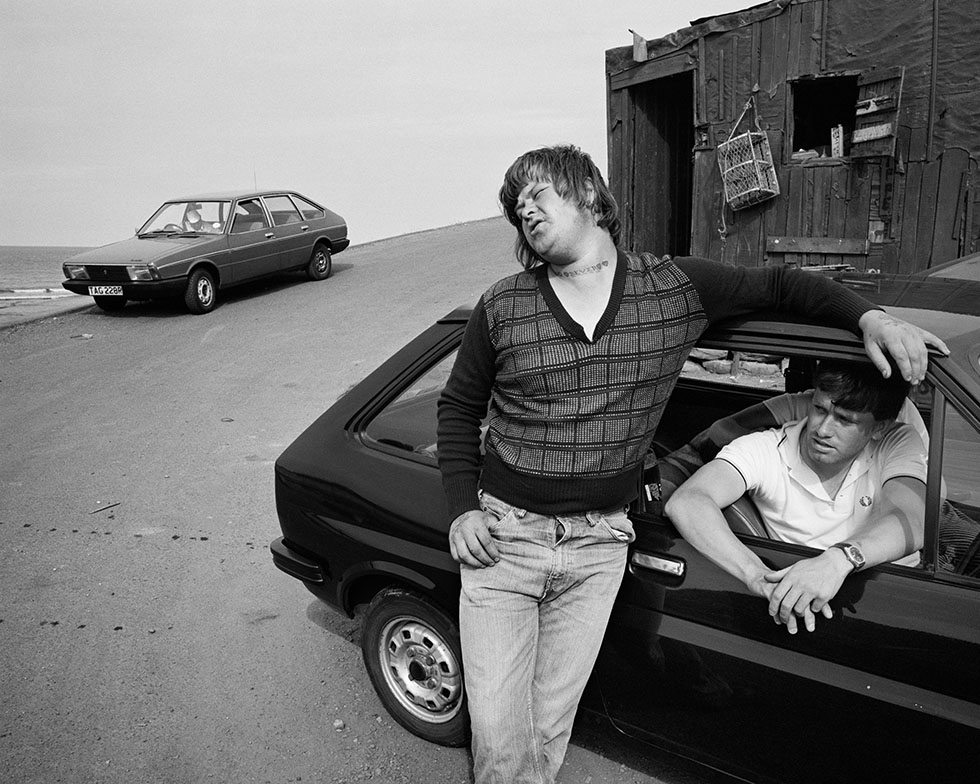
Killip arrived looking, but he also arrived as someone who could be looked at, classified and distrusted: an outsider with a large camera and intentions the village had no obligation to accept. The observer was already inside the social field he hoped to observe.
The usual story of documentary authority becomes harder to sustain at that point. Photography is often described as a sequence of decisions made by the photographer: where to go, when to raise the camera, how close to stand, which frame to publish. Skinningrove makes another set of decisions visible. A community can watch the photographer, refuse him, test him, tolerate him, joke with him, grant access or withdraw it.
The subject is not simply available.
Familiarity eventually allowed Killip to make photographs that would have been difficult for a passing visitor. It did not convert Skinningrove into transparent knowledge. His later account still begins from the village’s opacity to outsiders, and that opacity should not be mistaken for a problem that persistence finally solved.
Access is better understood as something continually produced among people who do not hold equal power over the resulting image. The people in Skinningrove shaped what could happen in Killip’s presence; Killip still decided which exposures became photographs, prints, sequences and public memory.
Long familiarity also complicates any neat opposition between candid photography and consent. A photograph can emerge from an accepted relationship without being staged. Someone can tolerate or welcome a photographer’s presence without controlling every later use of the image. Participation in an encounter does not make every future meaning mutually authored.
The encounter is co-produced. The photograph remains Killip’s authored object. Relational does not mean equal.
V. The Station
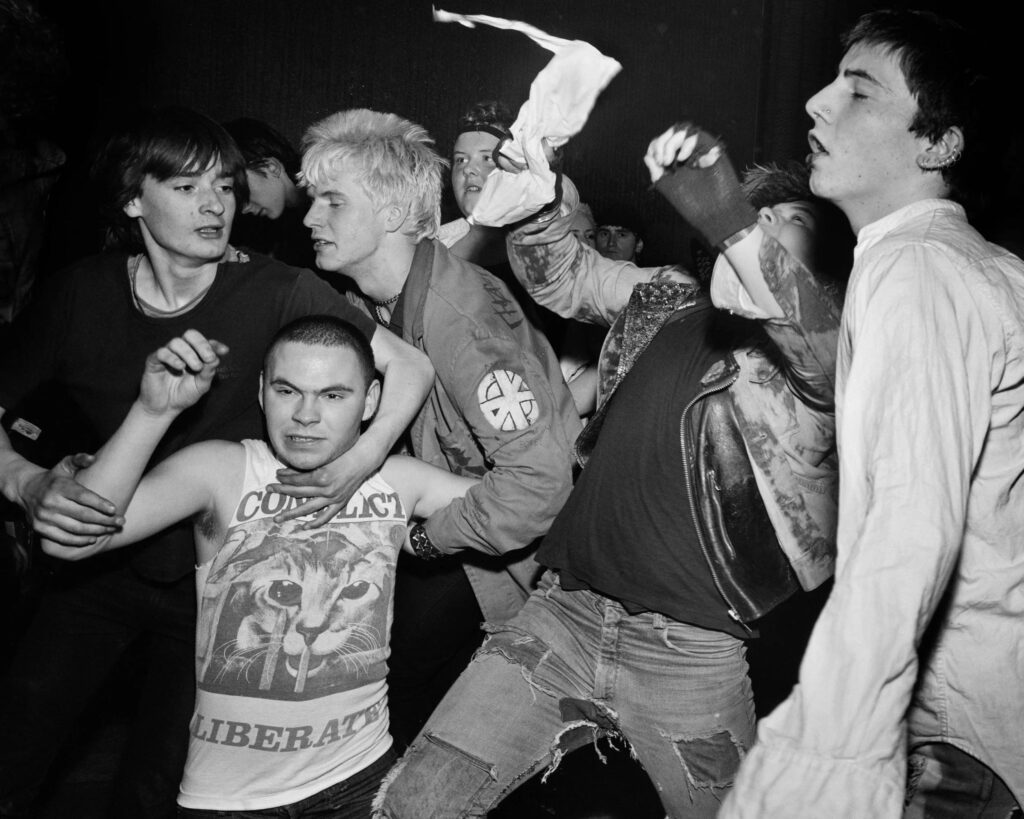
In 1985 Killip found a different social register at The Station (opens in a new tab), an old social club on waste ground in Gateshead that had become a punk venue. He described being startled by its energy. The place was run for and by the people who used it, and he returned on Saturdays throughout the summer with a 4×5 camera and flash.
The economic setting offered no clean break from the rest of his work. The miners’ strike had just ended and youth unemployment was high. Yet The Station does not fit easily into an elegy for industrial Britain.
Inside the venue, young people had made something of their own: clothes, hair, music, desire, aggression, jokes, alliances and a place in which those things could become public. Killip remembered that nobody seemed particularly interested in the conspicuous thirty-nine-year-old man with the large camera. Their attention was largely elsewhere.
That indifference decentres the photographer without making him invisible. The people at The Station were already making themselves visible to one another before Killip arrived, and their clothes, hair and gestures were not simply surfaces covering a more authentic self underneath. They were among the materials through which public identity became recognizable in the room.
Killip’s flash intensifies that visibility. Faces, leather, studs, hair and bodies jump forward against dark interiors. The camera did not invent the venue’s social world, but it entered that world and altered the conditions under which a moment became visible. Some subjects ignore him, some acknowledge him, some perform toward the camera. The finished photograph cannot always separate those responses cleanly.
Placed beside Seacoal, The Station prevents Killip’s work from hardening into a single story about deprivation. At Lynemouth, people make a livelihood from the residue of industry. In Gateshead, young people make a cultural space amid unemployment. Both situations are structured by forces larger than the individual, but neither reduces the people inside them to those forces.
The Station makes the point about dignity without needing the word. These young people do not wait for photography to restore social worth to them. Style, pleasure, affiliation and self-invention are already under way. Killip adds another form of attention and duration.
VI. What the Photograph Keeps
Years later, time changes the relation again.
In Skinningrove, Killip photographed David and a friend known as Whippet standing in a stream (opens in a new tab), waiting for salmon. Killip later recalled that it was the last photograph he made of David. Two years afterward, David and Killip’s friend Lezo drowned when their fishing boat overturned.
The death is not hidden inside the earlier photograph waiting to be decoded. David does not become a prophecy because the viewer learns what happened later. He remains alive in the recorded moment, occupied with the water and the activity before him. Later knowledge adds another context; it does not reveal the image’s final truth.
Killip spoke about photography in relation to mortality because every exposure records a moment that is already leaving. His hope was that when people died, the photographs might allow them to be remembered well. That is a modest claim compared with the old ambitions of documentary reform. Photography cannot prevent a death, reverse industrial policy or restore a vanished community. It can keep an appearance, gesture and relationship available to people who come later, where new contexts will continue to gather around it.
The Seacoal photographs acquired that function in ways Killip could not fully have anticipated. When he returned decades later (opens in a new tab), the mine and power station had disappeared, the camp had gone and the site had been landscaped. He regarded the photographs and his book as important surviving evidence that the community had existed.
Evidence again, but not recovery. The photographs preserve contact with people, places and relations that have changed or disappeared. They preserve traces, not intact lives; no later caption, sequence or archive can close every context around them.
Rocker makes that limit especially clear. Killip photographed him repeatedly as a child and stayed in contact with his family after he stopped working at Lynemouth. More than thirty years later, Getty recorded (opens in a new tab) that Rocker had become a leading harness-racing driver in Britain.
The later Rocker does not reveal the true person who had been hidden behind Rocker and Rosie Going Home. Nor does the childhood photograph become false once we know what followed. Each context changes what can be seen in the other without exhausting either one.
Return to the cart and the social history still matters: the sack, the beach, the waste coal, Killip’s years at Lynemouth. So does the later life that the frame could not contain. Adding that history does not complete Rocker or Rosie. It changes the reading without closing it.
Killip came close enough for lives to become particular without mistaking particularity for possession. The closeness matters because the distance does not disappear. What survives is the relation itself, still unfinished.
J’Ouvert follows the same Jab Jab crew, Grenadian by heritage, since 2022. They have copies of the pictures now, and we talk before and after each year. The distance the essay describes has not closed, but it is no longer the only thing in the room.
Works Cited & Further Reading
- Chris Killip Photography Trust, In Flagrante (opens in a new tab).
- Chris Killip Photography Trust, Seacoal (opens in a new tab).
- Chris Killip Photography Trust, Skinningrove (opens in a new tab).
- Chris Killip Photography Trust, The Station (opens in a new tab).
- J. Paul Getty Museum, Now Then: Chris Killip and the Making of In Flagrante (opens in a new tab), 2017.
- James Cuno, “Chris Killip on Photographing People and Places” (opens in a new tab), Getty Art + Ideas, 2017.
- J. Paul Getty Museum, Now Then audio tour (opens in a new tab), including Killip’s recollections of Lynemouth and Skinningrove.
- David Campany, “The Time of Chris Killip” (opens in a new tab).
- Museum of Modern Art, New York, Chris Killip, Rocker and Rosie Going Home, Seacoal Beach, Lynemouth, Northumberland (opens in a new tab).