A Postmodern Defense of Street Photography Against Susan Sontag’s Moralism
Sontag diagnosed postmodern image culture, then judged it with a modernist moral vocabulary. A committed postmodernist defends street photography through situated responsibility, not innocence.
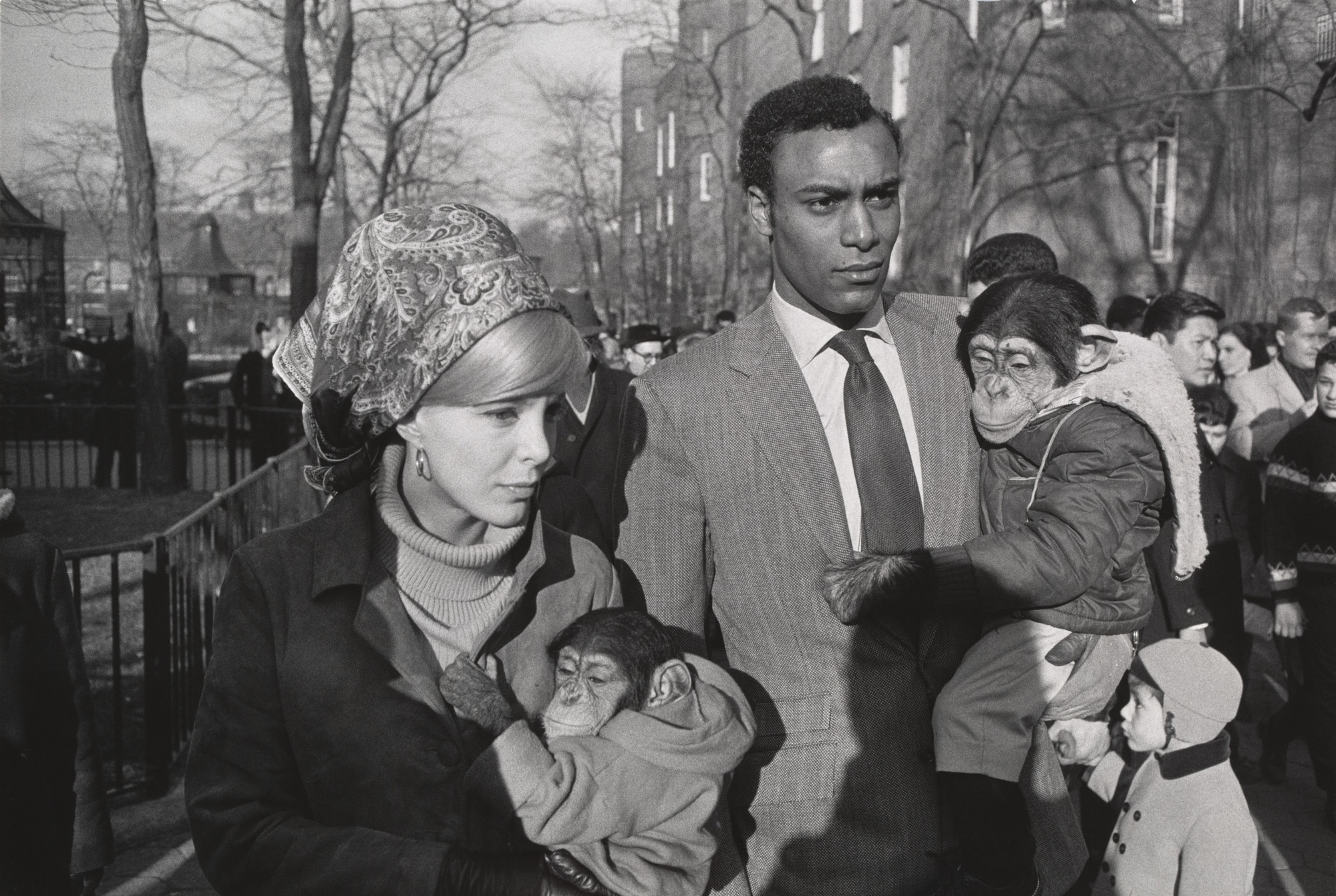
In Garry Winogrand’s Central Park Zoo, New York (1967), a Black man and a white woman walk toward the camera, each holding a young chimpanzee dressed in children’s clothes. The visual rhyme is immediate. So is the discomfort. The photograph can be read as an absurd family tableau, a record of urban spectacle or an image entangled with the racist history of comparing Black people to apes. None of those readings can be settled by discovering what Winogrand intended.
That instability is often used to defend street photography. The photographer does not control the final meaning, so the argument goes, and therefore cannot be held responsible for every interpretation. But uncertainty can become an alibi as easily as it can become a form of humility. Winogrand still selected the instant, organized the frame and allowed the photograph to enter a culture whose visual histories exceeded him.
Susan Sontag understood the camera’s power to transform an encounter into an image that could be possessed, circulated and consumed. When I first read On Photography in graduate school, her severity felt like moral clarity. With each return, it felt more like a verdict delivered before the evidence. The more I photographed in public, the less her universal suspicion could account for the variety of relations a camera creates.
I now understand the disagreement differently. Sontag diagnosed postmodern conditions without accepting postmodernism as her method. Her moral vocabulary retained modernist commitments to hierarchy, reality and authoritative judgment even as her own analysis showed those categories becoming unstable. The tension lies inside her criticism, not simply between her position and mine.
I come to street photography as a committed postmodernist. I do not claim that the camera is innocent. I claim that its ethics cannot be decided in advance by a universal verdict on the medium. Meaning and responsibility are produced among photographer, photographed person, editor, platform and viewer. They remain situated, unequal, revisable and contested.
I. Sontag Diagnosed the World She Feared
The opening of On Photography describes photographs as objects that accumulate, travel and alter what people believe is worth seeing. Photography does not merely represent the modern world. It helps produce an image-world that can be collected and carried away.
That analysis is remarkably close to a diagnosis of postmodernity. The photograph detaches appearances from their original circumstances. It places distant people and events beside one another. It converts difference into a common currency of images. High art, advertising, atrocity, family snapshots and pornography enter the same visual environment. Hierarchies weaken as everything becomes available for comparison and consumption.
Sontag saw this before social media feeds, search engines and generative image systems made it ordinary. She understood that photographic meaning does not remain where it began. Her mistake was not a failure to recognize postmodern conditions. It was her refusal to live with their implications.
She made that refusal explicit. In a 2001 interview about postmodernism, Sontag called herself “unquestioningly” loyal to the high-cultural canon. She rejected postmodern leveling, denied being a relativist and said that she wanted to address suffering “with the tools of modernism.” When the interviewer suggested that On Photography had pioneered an account of postmodernity, she accepted photography’s leveling force but rejected the label.
Sontag’s diagnosis and refusal form the contradiction that matters. Sontag diagnoses the postmodern image-world and recoils from it. She values discrimination, hierarchy, seriousness, reality and universal moral judgment. Those commitments give her criticism force. They also lead her to treat photography’s instability primarily as loss: loss of authentic experience, loss of historical understanding, loss of moral response and loss of an unmediated relation to reality.
The point is not to fix Sontag as modernism’s relic. The relic is a structure of judgment that her criticism both inhabits and unsettles. She encounters fragmentation and tries to recover wholeness. She encounters plural meanings and looks for a morally authoritative one. She encounters mediation and asks what happened to reality before the image intervened.
The postmodern answer is not that reality has disappeared. It is that we never encounter reality without frames, languages, institutions and histories. Photography does not cause that condition. It makes the condition difficult to ignore.
II. The Modernist Court
Sontag’s criticism repeatedly draws its moral energy from oppositions: reality and image, experience and representation, engagement and detachment, witness and voyeur, active photographer and passive subject. One side appears alive, present and ethically serious. The other appears derivative, distancing or corrupt.
These oppositions are persuasive because they name genuine risks. A person can hide behind a camera. An image can aestheticize pain. Looking can replace action. The ability to photograph another person is not distributed equally, and neither are the consequences of being seen.
But a risk is not an essence. Looking can distance, but it can also produce knowledge, identification or political pressure. A photograph can turn suffering into spectacle, but a lack of photographs can protect those responsible for it. Representation can displace experience, yet experience becomes socially intelligible through representation. The terms Sontag separates are already implicated in one another.
Postmodernism becomes more than a style of skepticism when it examines the dependency inside those oppositions. Deconstruction does not reverse the hierarchy and declare images superior to reality or voyeurism superior to witness. It asks how each category depends on the one it excludes. There is no innocent act of seeing before culture. There is no unframed reality to which a photograph could simply remain faithful. There is also no image floating free of bodies, events and consequences.
Sontag’s later work partly recognizes this. In “Looking at War”, which became part of Regarding the Pain of Others, she explains that the same photograph can sustain opposing political responses. Captions redirect meaning. What an image shows must be judged beside what it withholds. She rejects the assumption that viewers constitute a single moral “we.”
This later Sontag is a more difficult opponent because she has begun to undo her own earlier generalizations. She even praises Jeff Wall’s entirely constructed Dead Troops Talk as a serious image of war. Evidently, fabrication does not automatically sever a photograph from moral reality, just as documentary status does not guarantee truth.
Yet she continues to defend concrete reality against theories of simulation and universal moral standards against relativism. Her position becomes more nuanced without becoming postmodern. She permits contextual interpretation, but she does not surrender the hope that criticism can speak from stable moral ground.
My disagreement begins at that point. I do not believe such ground exists outside the relations being judged. Ethics does not descend on a photograph from a neutral height. It emerges through the encounter, its history, its circulation and the unequal power of everyone involved.
III. No One Owns the Photograph
Winogrand’s Central Park Zoo makes that distributed relation visible. The people in the frame contributed their bodies, clothes, gestures and proximity. Winogrand contributed timing, position, selection and the rectangular organization that turned coincidence into visual argument. Editors, museums and histories of street photography later made the picture canonical. Viewers bring racial memory, political commitments and changing expectations to it.
No participant controls the whole photograph. That does not mean every participant has equal power.
Roland Barthes helps remove the photographer’s intention from the position of final authority. A maker cannot issue a permanent instruction for what an image means. But the “death of the author” does not transfer all responsibility to the viewer. Winogrand’s intention cannot close the photograph, yet his decisions remain part of what happened. Interpretive openness adds participants to the ethical relation. It does not erase the person who pressed the shutter.
The photographed person is not sovereign either. A glance into the lens, a pose or a refusal can alter the picture, but it may not determine whether that picture is selected, captioned, sold or recirculated decades later. Agency can be real without being complete. Power can circulate without becoming equal.
The variation among photographic encounters makes it misleading to speak of “the street photographer” and “the subject” as fixed moral types. Compare Winogrand’s candid encounter with Jamel Shabazz’s account of working in Brooklyn. Shabazz often approached people, explained what he saw, invited poses and gave one of the resulting prints back. He describes the photograph as evidence of a conversation. Photographer and photographed person still occupy different positions, but the relation has been deliberately reorganized.
That does not make collaboration pure. A person can consent to being photographed without anticipating every future audience. A photographer can work respectfully and still benefit more from the image. Conversely, a candid photograph made without explicit permission can acquire historical or personal value its maker never foresaw.
The point is not that no judgment is possible. The point is that the moral identity of a photograph cannot be deduced from a category such as candid, posed, documentary or street. It must be judged as a specific relation with a specific afterlife.
IV. The Street Is a Relation, Not a Verdict
Sontag often writes as though the decisive ethical event occurs when the camera converts a person into an image. That moment matters, but contemporary circulation makes the photograph’s life much longer than its exposure.
A street photograph is transformed when the photographer chooses one frame over another. It changes again when it receives a caption, enters a sequence or appears beneath a title. A book, gallery, newspaper and social platform do not present the same object, even when they reproduce the same file. Each context recruits a different audience and supplies different expectations.
Digital circulation intensifies these transformations. A picture can be detached from its sequence, stripped of its caption, searched by face, converted into a meme, offered to an algorithm or encountered years later by the person it depicts. The original photographer may lose practical control while continuing to receive credit, income or blame. The photographed person may gain a public voice or face a new exposure. Viewers and platforms become active participants rather than neutral destinations.
The point becomes clearer through Ariella Aïsha Azoulay’s relational account of photography. A photograph is not simply a product delivered by a photographer to a spectator. It belongs to an encounter whose participants retain claims on one another. Those claims do not end when the shutter closes.
A postmodern ethics follows the image through those successive relations. At capture, it asks about proximity, vulnerability, refusal and the photographer’s use of surprise. At edit, it asks what selection intensifies or conceals. At publication, it asks what a caption claims to know. At circulation, it asks who gains reach, status or money and who absorbs the risk. At viewing, it asks what pleasures and assumptions the audience brings.
None of these questions supplies a permanent formula. That is not an ethical weakness. It is a recognition that responsibility returns whenever the relation changes.
Sontag’s universal suspicion of the camera compresses this entire life into one original sin. A celebratory defense of street photography makes the opposite mistake and treats public visibility as automatic permission. Both positions decide too much in advance. The street is neither a zone of pure exploitation nor a democratic commons without owners. It is a field of unequal encounters whose meanings remain open and whose consequences remain real.
V. Ethics Without Innocence
The familiar accusation against postmodernism is that if truth is contextual, anything can be justified. That is not my postmodernism. I do not believe anything goes. I believe no judgment comes from nowhere.
A situated judgment can still be severe. It can identify humiliation, manipulation, racial coding, economic extraction or foreseeable danger. What it cannot do is pretend that one rule settles every photograph before the details of its making and use are considered.
Consent matters, but it is not a magic solvent. A “yes” given on the street may not include a future advertising campaign or viral audience. The absence of explicit consent does not make every candid photograph equally injurious. Vulnerability matters, but it is not always visible. Public interest matters, but photographers routinely flatter themselves about serving it. Intention matters, but good intentions cannot cancel consequences.
The ethical photographer therefore needs something more demanding than innocence. They need answerability. Can the choice of frame be explained without reducing a person to a type? Was vulnerability recognized or exploited? Could the image be captioned without pretending to know an interior life? Would the photographer reconsider publication if circumstances changed? Who can contest the photograph’s use, and whose objection will carry weight?
These questions do not create a checklist that guarantees virtue. They keep judgment open to revision. A photograph can be legal and cruel. It can be made without permission and become socially necessary. It can begin collaboratively and later be used in betrayal of that collaboration. Ethical status is not stored permanently inside the image.
Sontag’s moralism remains useful wherever it interrupts complacency. She refuses the photographer’s fantasy that looking is automatically generous. She insists that aesthetic pleasure can coexist with domination and that images may dull the very response they appear to solicit.
What I reject is her need to turn those warnings into a verdict on photography itself. Postmodernism does not remove the asymmetry she identifies. It prevents that asymmetry from hardening into a complete theory of every encounter. It also adds the responsibilities of institutions, platforms and viewers that a photographer-centered morality leaves too easily outside the frame.
VI. A Defense Without a Final Court
Why defend street photography if it cannot be declared innocent? Because public life deserves an account not produced only by governments, corporations, police cameras, advertisers or official events. The street photograph can preserve improvised gestures, private styles made public, temporary alliances and collisions that institutional images overlook.
That value is conditional. A street photograph does not become democratic merely because it was made in shared space. It can reproduce stereotype, convert vulnerability into style or confuse access with entitlement. It can also preserve evidence, complicate official history and show people inventing ways to inhabit a city. The form contains no moral guarantee in either direction.
The absence of a final court is precisely why I remain a postmodernist. I distrust the fantasy that one critic can stand outside the image-world and pronounce a final moral law for everyone inside it. I also distrust the photographer who uses ambiguity to escape accountability. Both want exemption from the difficult work of situated judgment.
Winogrand’s Central Park Zoo remains uncomfortable because its meanings cannot be sealed. That uncertainty is not the photograph’s innocence. Nor is our discomfort proof that the picture should not exist. The photograph has outlived its encounter and now activates histories that no single participant owns. Each new context changes what must be judged.
Sontag saw this image-world coming, and her later revisions show that she did not simply stand outside it. Her brilliance was diagnostic. Her unresolved tension lay in wanting situated interpretation and a moral authority that could exceed situation. Assigning her to modernism and myself to postmodernism cannot close that tension; my own categories remain part of the contest.
I do not defend street photography by claiming that it transcends ethics. I defend it against the belief that ethics can be completed once and for all. Meaning remains unstable. Power remains unequal. Responsibility therefore remains active.
Postmodernism does not acquit the photographer. It abolishes the fantasy of a final court. Street photography must remain answerable.
No one owns the photograph, and meaning made between frames is the premise of Pairs: Repetition and Différance.