Why I Reject the Pretense of Documentary Neutrality
Neutrality taught me useful disciplines: verify, do not stage and do not let a caption outrun the evidence. It also taught me to mistake professional restraint for the absence of a position. Rejecting that fiction does not make subjectivity virtuous. It makes the photographer more answerable for what an image claims and what happens after…
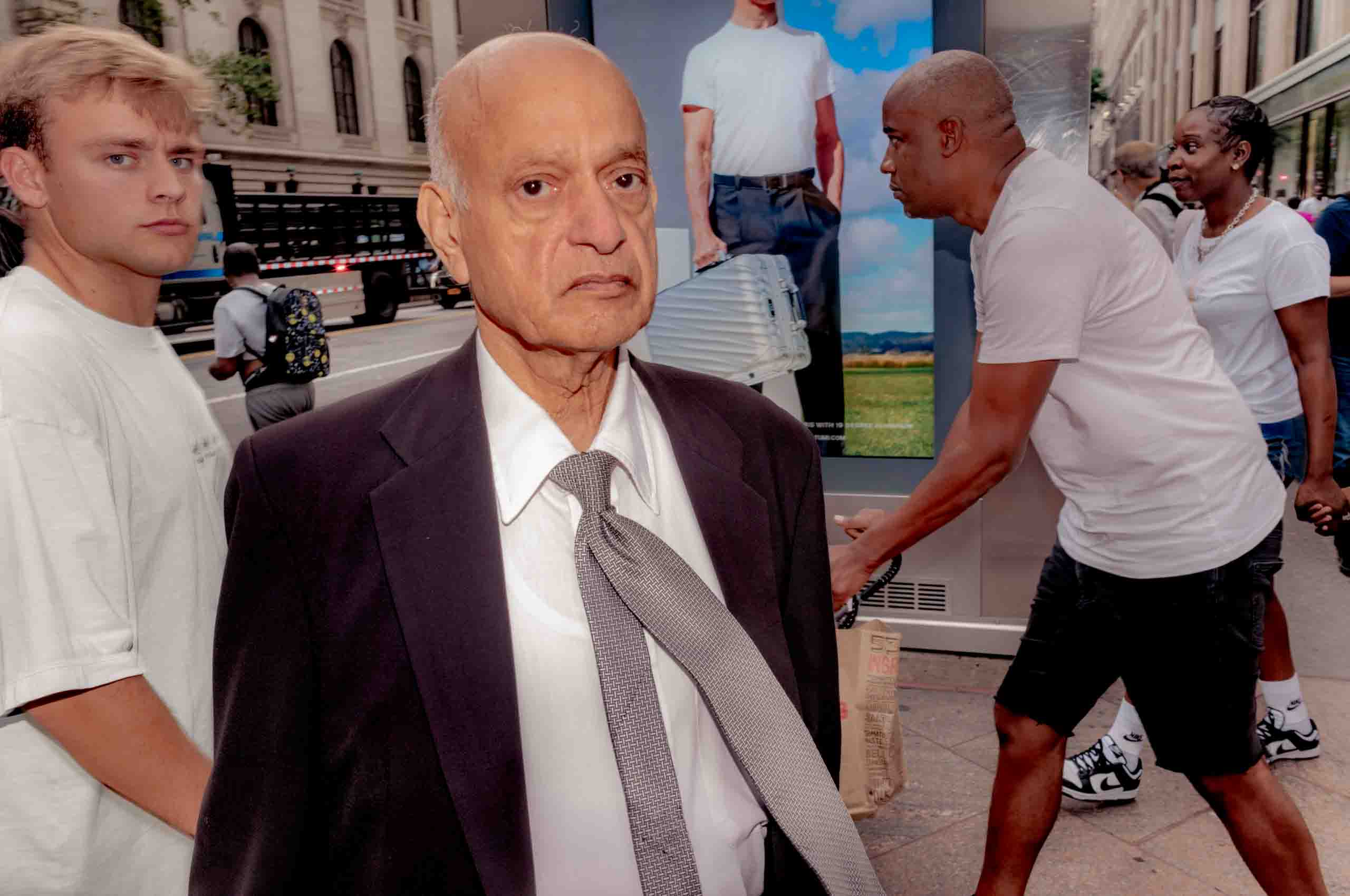
I did not notice the advertisement when I made White Shirts.
I saw the older man in the dark suit, the angle of his tie and the younger man looking directly into my camera. I saw white clothing moving across the frame. I saw the hard light flatten the street into a surface of bodies, fabric and glare. The advertisement behind them registered as background.
It became important later, while I was editing. On my monitor, its idealised torso began to repeat the people in the street. The commercial image and the four men appeared to belong to one system of display. A photograph I had made quickly now seemed to contain an argument about clothing, aspiration, class and public visibility.
The street had supplied the material. I had supplied the distance, the instant and the edge of the frame. The argument emerged afterwards, through selection.
During my journalism training, I absorbed a professional vocabulary that made this sequence difficult to describe. Ethical photography meant accuracy, restraint and resistance to manipulation. The photographer should avoid staging, verify captions and keep personal convictions from overwhelming the evidence. These were valuable obligations. I still believe in them.
They arrived, however, inside a larger story: that disciplined practice could make the photographer recede. Subjectivity was treated as interference. Neutrality named the condition in which the record could speak with authority because the person making it had learned not to intrude.
My photographs did not teach me that accuracy was meaningless. They taught me that accuracy and neutrality had been falsely joined. A picture can refer to something that happened while remaining inseparable from the person who framed, selected and circulated it.
Rejecting neutrality therefore solves less than it first appears to. Declaring a position can become another professional ritual, a performance of self-awareness that leaves the underlying decisions untouched. “I am situated” can conceal responsibility almost as effectively as “I was only documenting.”
The question is no longer whether I can remove myself from the photograph. I cannot. The harder question is what I owe the people, places and histories that become material for my work once I acknowledge that I am there.
I. The Virtue I Inherited
Neutrality did not enter my education as an abstract philosophical claim. It appeared through rules of conduct.
Do not stage a documentary event and present it as spontaneous. Do not alter the material content of an image. Do not write a caption that claims more than the available evidence. Verify names, places and dates. Recognise that a photograph can cause harm after it leaves the circumstances in which it was made. These obligations remain visible in the National Press Photographers Association’s Code of Ethics (opens in a new tab).
These disciplines protect distinctions that matter. A fabricated event is not equivalent to a witnessed one. A wrong name is not one interpretation among many. Removing an inconvenient person from a frame is different from adjusting exposure. The fact that all photographs are mediated does not erase the difference between an incomplete record and a deceptive one.
Neutrality gave those obligations a moral identity. The restrained photographer appeared trustworthy because personal desire had been subdued. Authority seemed to come from the event rather than from the decisions made around it.
I understand the attraction. The photographer has unusual control over what remains visible. Professional restraint offers a defence against vanity, sensationalism and the urge to turn every encounter into proof of a prior belief. It asks the photographer to serve something beyond the image’s style or the maker’s reputation.
The problem begins when restraint is mistaken for absence.
While completing my journalism thesis on the ethics of press representations of homelessness, I examined how distance, gaze, sourcing and recurring social roles shaped the people who became visible in news coverage. I was already suspicious of the idea that photographs simply reflected the world. The patterns were produced through selection and repetition.
Looking back, however, I can see that the research still partly inhabited the language of professional correction. Bias appeared as something that a more accurate system might identify and repair. Better representation remained imaginable as a position from which the distortions of earlier representation could be measured.
The research did not lead me to abandon evidence. It changed where I located the problem. An authentic photograph could participate in a distorted account without containing a visible falsehood. Every individual frame might satisfy conventional rules while the accumulated archive produced a narrow social type.
Neutrality could identify a staged scene or an inaccurate caption. It struggled to account for the quieter decisions through which some pictures became normal and others remained unseen.
The photographer had not disappeared. Authorship had been distributed across assignments, access, habits, captions, editing and repetition, then disguised as procedure.
II. When Procedure Hid the Author
A camera records what enters its field. It does not decide why that field begins and ends where it does.
The distinction sounds obvious, yet professional procedure can make framing feel less like an action than a technical necessity. A photographer must stand somewhere. A lens must have a focal length. The shutter must be released at one instant rather than another. An editor must eventually choose a frame.
Because these decisions are unavoidable, they can come to seem ethically neutral. They become the machinery through which the event passes rather than acts that organise what the event will become for someone who was not there.
White Shirts resists that account. The photograph’s central relation was not something I consciously recognised when I raised the camera. It emerged through editing. Selection did not merely identify the strongest record of what I had already understood. It produced a new way of understanding what I had seen.
That does not mean the picture invented its people or its setting. The men stood on that street. The advertisement was behind them. One man looked into the camera. Their clothes reflected the same light.
Yet the photograph makes those elements answer to one another. It turns proximity into resemblance and resemblance into a possible social argument. The composition invites the viewer to treat a group of strangers and an advertisement as parts of the same visual sentence.
The meaning is neither wholly in the world nor wholly imposed by me. It forms through the relation between what occurred, what I noticed, what I failed to notice, what the camera included and what I later chose to keep.
Neutrality cannot describe that process because it needs the world and the observer to remain separable. One supplies the fact; the other either preserves or contaminates it.
Photography is less orderly. The picture may show me something I did not consciously intend. That discovery does not make the camera autonomous. I am still the person who recognises the pattern, names the photograph, places it in a sequence and decides that the relation deserves public attention.
The ethical difficulty lies partly in that delayed authorship. A street encounter lasting a fraction of a second can be interpreted for hours, published years later and made to support a claim that did not exist at the moment of exposure.
The shutter does not complete the documentary act. It begins a chain of decisions.
III. Three Photographs That Would Not Let Me Disappear
White Shirts
White Shirts unsettled my belief that intention could define the limits of authorship.
I had not directed the men or arranged the advertisement. I had not consciously formulated the picture’s argument. That might allow me to call the photograph found, as though its meaning had been waiting intact on the street.
But the relation became a photograph because I selected it. Other exposures did not receive the same attention. The frame gained a title. The title strengthened one interpretation. Publication placed four people inside an argument they had never agreed to illustrate.
The discovery was real. So was the authority through which I converted it into a work.
The photograph therefore makes two claims at once. Something happened beyond my control. I also shaped what that occurrence would become for others.
Neutrality allows only the first claim. Pure subjectivity would exaggerate the second. The photograph depends on both.
Fifth Avenue

On Fifth Avenue, two older men face my camera. One points towards me while holding a cane. The other raises his hand across his face.
The lifted palm interrupts the image and completes it. Without that gesture, the photograph would describe two men occupying a street. With it, the encounter becomes visible. The picture records someone resisting the conditions under which the picture is being made.
My proximity is no longer an invisible fact behind the frame. It has entered the behaviour inside it.
For a time, I treated this kind of response as evidence of honesty. The photograph acknowledged the camera. It did not pretend that public life continued untouched by my presence. Resistance became part of the record rather than an inconvenience to crop away.
That remains true, but it is not enough.
The man’s hand did not give me permission. His refusal became visually useful to me. I converted a boundary into the photograph’s central gesture. The picture may be more truthful about the encounter because it includes that resistance, but its reflexivity does not settle whether I should publish it or how I should describe what occurred.
Making power visible is not the same as redistributing it.
The image changed my understanding of neutrality because it proved that the photographer could not always remain outside the event. It later changed my understanding of self-awareness because it showed how easily another person’s objection could become evidence of my ethical sophistication.
The photograph implicates me. It does not absolve me.
Columbus Circle

At Columbus Circle, a sign reading PHOTO ENFORCED hangs above two men standing beside a food cart. One looks directly into my camera. The other touches his face.
The visual rhyme is immediate. A warning about automated traffic enforcement becomes a commentary on my own act of photographing. The sign, the camera and the returned look form a small circuit of surveillance.
I enjoy the picture. That pleasure matters.
The photograph is organised around an accidental joke. I noticed the sign, the men and the possibility of holding them together in one frame. The success of the image depends on timing, proximity and the viewer recognising the same collision.
The men did not place themselves there to embody an argument about photography. Within the composition, however, their presence carries the joke. Their bodies give the sign its second meaning.
Calling the image ambiguous does not release me from that use. Calling it art does not make the use illegitimate. The question is more precise: what does my pleasure ask these particular people to become inside the picture?
They remain more than the roles the composition gives them. The man looking into my camera has a history, attention and intention that the photograph cannot contain. I do not know what he thought about me, the sign or the moment. The frame preserves his look while withholding almost everything that would explain it.
The picture’s incompleteness is part of its force. It is also a limit on the claims I can responsibly make.
Neutrality would treat the scene as something I happened to witness. A crude account of subjectivity would declare that the image is simply my interpretation. Neither position addresses the uneven relation through which strangers become material for a visual idea.
The joke is mine. The bodies are not.
IV. The Confession That Solves Nothing
Once neutrality is rejected, the photographer can become conspicuously present.
The essay moves into the first person. The camera’s influence is acknowledged. Captions describe the encounter. The maker admits desire, uncertainty and complicity. The hidden observer steps into view.
This can improve the work. It can also become a new alibi.
Gaye Tuchman described journalistic objectivity as a “strategic ritual” (opens in a new tab): a set of procedures through which professional authority is defended under pressure. Reflexive confession can perform a similar function when acknowledging situatedness substitutes for changing the decisions that follow.
A declaration of subjectivity may sound ethically serious while changing nothing about how an image is selected, captioned or circulated. The photographer confesses to having power and then continues to exercise it exactly as before. Complicity becomes a theme rather than a condition requiring decisions.
I recognise the danger because it is available throughout my own practice. I work close. People sometimes look back, react or challenge me. Those gestures make the encounter visible and often strengthen the photograph. They also allow me to present proximity as evidence that I have escaped the detached gaze I criticise.
But closeness has no fixed moral value. It can create recognition or confrontation. It can make the photographer accountable to a returned look. It can also intensify intrusion. A photograph does not become ethical because the person pictured noticed it being made.
The same problem applies to theoretical self-awareness. Knowing that meanings are constructed does not determine which interpretation is responsible. Knowing that authorship is distributed does not make power equal. Knowing that a subject exceeds the frame does not prevent the image from reducing them in practice.
“I am situated” is a description, not a verdict.
Accountability begins after that description. It appears in less glamorous decisions. What do I actually know about the scene? What am I inferring? Does the caption distinguish between the two? Am I using a gesture to diagnose a person? Does the sequence turn an exception into a type? Has the image gained a meaning through publication that I did not anticipate? What happens when someone pictured objects?
These questions do not produce a universal rule for street or documentary photography. They require judgment, and judgment remains vulnerable to error.
That vulnerability matters. A code of neutrality promises that correct procedure can stabilise the photographer’s authority. Reflexive confession can promise something similar: that exposing one’s position is enough to make the resulting authority honest.
Neither promise holds.
Accountability has to remain open to revision because the photograph continues to enter relations its maker cannot control. A caption can be corrected. An image can be resequenced, withheld or removed. A person pictured can bring knowledge that changes what the photographer thought the frame contained. A later historical context can expose an interpretation that once felt harmless.
The inability to control every consequence does not end responsibility. It makes responsibility ongoing.
V. A Discipline Without Neutrality
I do not want to replace professional restraint with the celebration of personal vision.
The photographer’s position matters, but it is not sacred. Intention can explain a decision without justifying it. Artistic freedom does not make factual care optional. Ambiguity cannot repair a false caption. The complexity of interpretation does not make every claim equally plausible.
Several obligations survive my rejection of neutrality.
I should not stage a documentary encounter and conceal the staging. I should not materially alter a scene while presenting the result as evidence of what occurred. Names, places and dates should be checked. A caption should not convert suspicion into knowledge. When I do not know why someone acted, the writing should not pretend that I do.
Selection also requires accountability. A single photograph can be accurate while a sequence distorts through repetition. An archive can produce a social type without any frame containing an explicit lie. What I publish repeatedly may matter more than the fairness of an isolated picture.
Circulation requires another form of judgment. A photograph changes when it leaves the circumstances in which it was made. A portfolio, essay, social feed, news article and institutional archive do not make the same use of an image. Publication is not a neutral delivery system. It creates a new encounter between the person pictured, the photographer and an audience neither of them may know.
No code can decide every case in advance. That does not leave me without standards. It means the standards must operate through particular decisions rather than through a claim that my position has disappeared.
Return to White Shirts.
The photograph still records a real conjunction of people, clothing, light and advertising. Its factual relation to the street matters. I could not have made that particular image without those people being there.
Its meaning is nevertheless inseparable from choices made later. I selected the frame because I recognised a relation. I gave that relation a title. I placed strangers inside an argument about how bodies and commercial images become visible together.
The people exceed that argument. I do not know their names, where they were going or how they understood the street around them. The photograph preserves less than a life and more than an invention.
Neutrality once offered a way to manage this imbalance by making the photographer conceptually absent. Subjectivity offers the opposite temptation: to make the photographer’s interpretation the centre of the work.
Neither position is adequate.
The photograph begins in an encounter that I did not control and continues through decisions that I do. Honesty requires me to distinguish between them. It asks me to say what the image shows, what I brought to it, what I learned only afterwards and what remains beyond my knowledge.
That account will never make the relation equal. It will not return the photograph to a moment before framing or circulation. It cannot guarantee that a picture will be used well.
It does, however, replace the fiction of disappearance with something harder to maintain: a record of decisions that remains open to correction.
The documentary record does not become credible when the photographer vanishes. It becomes credible when the photographer can account for what was done, what is known, what is being claimed—and what the frame still has no right to settle.
Works Cited & Further Reading
Sources supporting the essay’s account of documentary discipline, situated authorship and responsibility after circulation.
- Azoulay, Ariella. The Civil Contract of Photography (opens in a new tab). Zone Books, 2008.
- Barthes, Roland. Camera Lucida: Reflections on Photography (opens in a new tab). Hill and Wang, 1981.
- Berger, John. Ways of Seeing (opens in a new tab). Penguin, 1972.
- Inglis, Adam. Visual Representations of Homelessness in Press Photography: Ethical Consequences. Master of Journalism thesis, Monash University, 2016. Public PDF link pending.
- Linfield, Susie. The Cruel Radiance: Photography and Political Violence (opens in a new tab). University of Chicago Press, 2010.
- National Press Photographers Association. “Code of Ethics” (opens in a new tab).
- Sontag, Susan. On Photography (opens in a new tab). Farrar, Straus and Giroux, 1977.
- Tuchman, Gaye. “Objectivity as Strategic Ritual: An Examination of Newsmen’s Notions of Objectivity” (opens in a new tab). American Journal of Sociology 77, no. 4 (1972): 660–679.