Double Exposure: How Kyoto and I Became Each Other’s Props
In Kyoto, tourists arrive with pictures already in mind, and the city adapts to help produce them. Photographing that circuit critically does not place me outside it. It makes my complicity the subject.
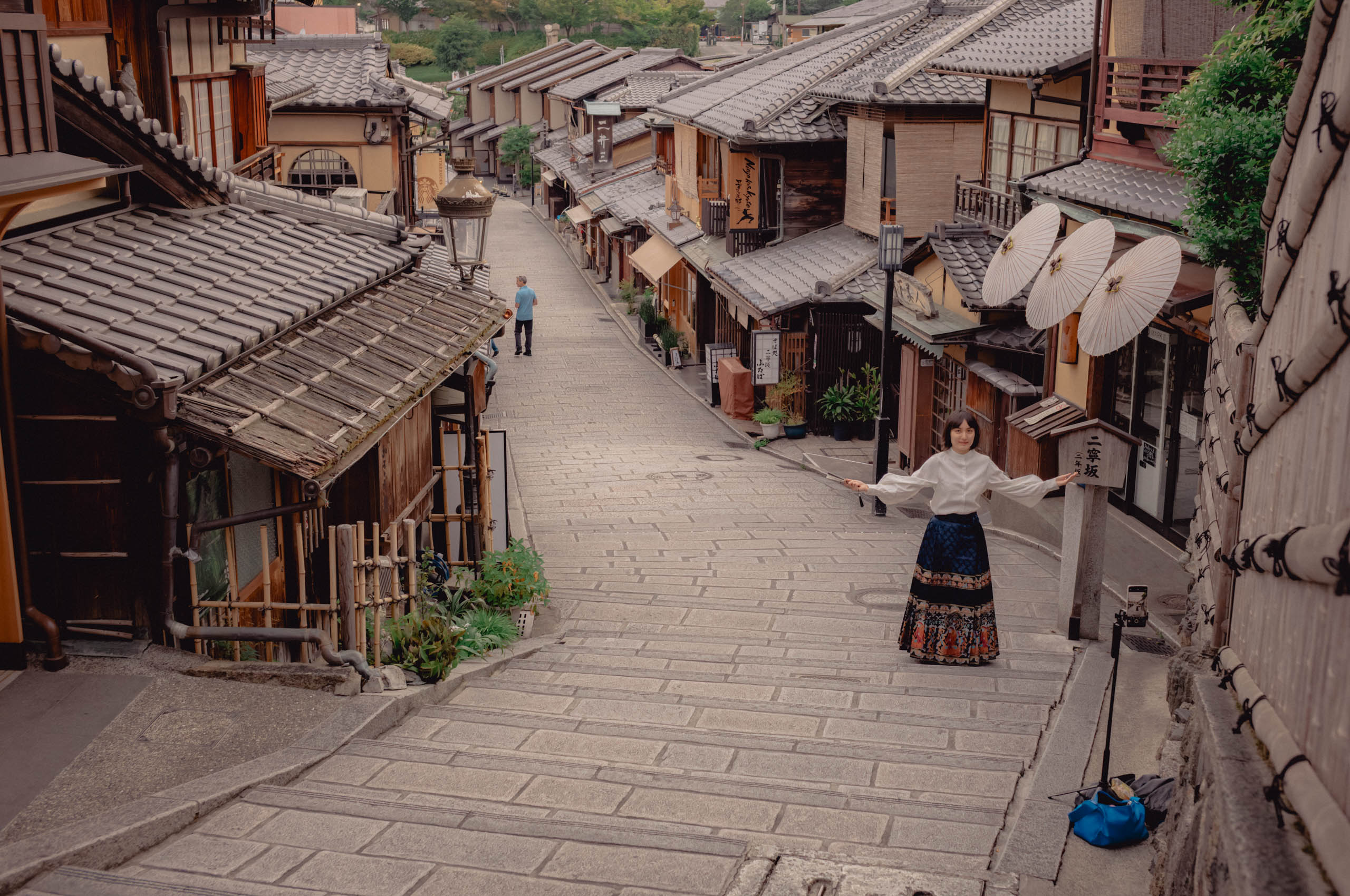
On a stone-paved street in Kyoto, a woman stands with her arms extended before a phone on a tripod. Three white parasols hang above her right shoulder. A blue bag sits beside the phone. Farther uphill, another visitor walks through the frame. The image she is making will probably look like a solitary encounter with an old city. My photograph includes the apparatus that produces that solitude.
That difference creates the double exposure. She uses the street to stage herself. I use her staging to make a picture about tourism. Kyoto is a prop in both images, but so is she. My critique depends on the scene I claim to stand outside.
The easy conclusion would be that social media has replaced a real Kyoto with a false one. I no longer believe that. Kyoto’s authenticity is not simply destroyed by tourism. It is reorganized through a circuit of expectations, businesses, heritage management, visitors, residents and images. Visitors arrive knowing what Kyoto should look like. Parts of the city and its tourism economy help them produce that look. Their pictures then teach the next visitor what to seek.
Jean Baudrillard (opens in a new tab) gives us a language for the moment when the model begins to organize the territory. But if hyperreality becomes a synonym for “fake,” it explains nothing and licenses contempt. The harder question is how to photograph this circuit without turning tourists into caricatures or local culture into a vanished original. I cannot answer that by announcing my complicity. I have to show what my looking does.
I. The Picture Before the Place

In one photograph, two visitors in kimono move through a narrow street. The floral pattern of her garment fills the left side of the frame. His black clothing forms a dark vertical beside the wooden facade. He is looking at a phone. She is looking down. Neither appears to be performing for my camera. The picture is quieter than the argument I once asked it to carry.
I could call the phone an intrusion and the clothing a costume. That reading would be immediate, legible and smug. It would also reproduce the fantasy that Kyoto’s traditions occupy one pure layer of time while digital life arrives from elsewhere to contaminate them. The phone, the rented garment, the old building and my camera belong to the same present.
John Urry and Jonas Larsen’s idea of the tourist gaze (opens in a new tab) is useful here because it shifts attention away from individual shallowness. Looking is socially organized. Guidebooks, films, advertising, family albums and platforms teach us which sights matter and how they should appear. Tourists do not arrive with empty eyes. They arrive with pictures already in mind.
Photographers do too. I know which collisions will read as “Kyoto” in my own archive. A robe beside a railway crossing. A phone held against a wooden facade. A warning sign beside the act it prohibits. I notice these scenes because they confirm an argument I was already prepared to make. The tourist’s shot list and my critical shot list are different, but neither is innocent.
II. The Rental Shop and the Feed

A headless mannequin stands outside a rental shop wearing a teal floral kimono. The sign across its body advertises the shop’s TikTok account and announces “6K followers.” Tradition, retail and platform visibility occupy the same small display. The follower count is not incidental. It is part of the product’s promise.
Treating rental kimono as copies without originals is too easy. The garments are material objects. The shops are local businesses. Dressing, walking, photographing and posting are real social acts, even when they have been designed for visitors. To call the whole encounter fake is to replace analysis with a purity test.
Baudrillard becomes more useful when the question changes. The issue is not whether the garment is real. It is how a circulating image of Kyoto begins to organize the experience sold on the ground. The customer arrives with a visual template. The shop packages clothing, styling, route and backdrop to satisfy it. The resulting photographs return to the feed, where they strengthen the template. The model and the place adjust to one another.
That circuit does not have a single author. Visitors bring desire and money. Platforms reward recognizable pictures. Rental shops translate culture into a service. Heritage sites manage access and visibility. Residents live with the resulting traffic. Photographers turn the entire arrangement into evidence. Power is not equal across those positions, but agency does not belong to outsiders alone.
This matters because the language of cultural loss can make Kyoto sound passive, as though a once-complete culture now waits to be consumed. Culture has never been still. Commerce can flatten meaning, but it can also sustain skills, employment and forms of participation. The ethical question is not whether change has occurred. It is who shapes the change, who benefits from it and who absorbs its costs.
III. The Reverse Gaze

At the foot of a broad flight of stone steps, a woman bends toward a phone mounted on a tripod. Behind her, several people have raised phones of their own. She is producing content while becoming content in other people’s frames. I stand at a further remove and photograph the whole arrangement.
It is tempting to imagine that my wider view exposes what her tighter frame conceals. Her image offers fantasy. Mine reveals production. Yet my photograph also depends on timing, exclusion and style. I turn her labor into a neat visual argument about self-display. The critical frame remains a frame.
Alex Gillespie’s account of tourist photography and the reverse gaze (opens in a new tab) clarifies this discomfort. A tourist photographer can imagine being judged by the people they photograph, but that imagined judgment may be their own criticism of other tourists returning to them. In Kyoto, the disapproval I attribute to the city can be my own embarrassment reflected back.
This is more precise than calling the camera a panopticon. My lens does not cause every action it records, and a person unaware of me is not automatically performing for me. The power lies in what happens next. I select the instant, place it in sequence, write the caption and circulate the result as an example of something larger.
Her phone is pointed at herself. My camera is pointed at her. Both acts participate in the same image economy, but they are not ethically identical. She authors a performance of her own body. I appropriate her performance for my argument. The title’s double exposure therefore names more than mutual participation. It names an asymmetry I have to own.
IV. How a Photograph Makes a Trespass

In another photograph, a warning sign fills the left foreground. Its English text says there is a risk of accident and instructs visitors not to sit on the banister. Just beyond it, a child sits on the rail. People in kimono and everyday clothing move through the crowded street behind. Part of an adult body closes the right edge of the frame.
The child’s act does not gain significance only because I witness it. The rule and the risk exist without me. What my photograph does is convert proximity into a sentence. Sign, child and crowd become instruction, violation and scale. The composition makes a trespass legible.
There are real reasons to take visitor conduct seriously. Kyoto’s official sightseeing guidance (opens in a new tab) asks people not to block roads, to observe photography restrictions and to refrain from photographing maiko. The city and tourism association have also developed broader guidelines for responsible travel (opens in a new tab). Congestion, trespass and harassment are material problems. Calling them spectacle does not make them less real.
But a photograph can turn one small breach into a symbol of an entire class of people. The person becomes “the tourist.” A child becomes evidence of entitlement. The frame suppresses whatever happened before and after because the visual rhyme is too satisfying to resist. This is where criticism can become moral theater of its own.
My responsibility begins with distinguishing what the picture shows from what I infer. It shows a warning and a child sitting where the sign says not to sit. It does not show the motives of the child, the response of a parent, the duration of the act or its consequences. A caption that converts those unknowns into a verdict would not strengthen the photograph. It would make the argument less honest.
V. Beyond the False and the Authentic

Two men in patterned robes stand beside a railway crossing. One adjusts the fabric at his waist. The other holds a phone and a bottle of water. Commuters and visitors cross behind them. Rails curve through the frame toward a crowded platform.
Nothing here needs to be sorted into traditional and modern, authentic and simulated. The clothes, railway, plastic bottles, phones and pedestrians coexist in one ordinary present. The urge to identify which element is the “real Kyoto” tells us more about the outsider’s desire than about the city.
Edward Bruner’s Culture on Tour (opens in a new tab) offers a useful correction to the authenticity trap. Tourist sites are not simple stages on which locals present a false culture to passive outsiders. They are contested border zones produced through stories, performances, commercial arrangements and encounters among people with different interests. What happens there can be staged and still be socially real.
This does not mean every exchange is harmless or that power disappears into hybridity. Kyoto’s own tourism body describes a city economically dependent on visitors while also confronting crowded transport, pressure on residential life and increasing resident dissatisfaction. Its account of tourism before and after the pandemic (opens in a new tab) is more complicated than either celebration or decline.
That complexity changes the questions worth asking. Who earns money from the experience and whose labor remains invisible? Which spaces are treated as public backdrops even when people live there? Who controls an image after it circulates? Which rules protect worship, work and everyday movement, and which ones merely preserve a marketable appearance? The language of authenticity cannot answer those questions by itself.
Kyoto does not survive by vanishing. It survives by negotiating change, sometimes badly, through institutions, residents, businesses and visitors who do not share the same power or goals. The city is not an ever-compliant prop. Describing it that way repeats the passivity the critique claims to oppose.
VI. What the Photographer Owes

A man in formal white clothing stands outside a wooden building and checks his phone. The phone could be made to expose a contradiction: ritual interrupted by technology, the present puncturing the past. Yet the photograph provides no basis for that story. He is simply a person in formal clothing using a phone.
That admission matters. Photography invites the conversion of visible detail into symbolic proof. A gesture becomes alienation. A costume becomes appropriation. A phone becomes the death of attention. Theories can sharpen those readings, but they can also make ordinary people carry claims they never consented to represent.
There is no neutral position available to me, but that does not make every position ethically equal. Legality is a floor, not a complete ethic. Consent cannot always be negotiated in candid street work. I can still decide which frames to publish, how to caption them, whether I obey restrictions and whether my prose turns a person into a contemptible type. I can separate observation from inference and leave room for what I do not know.
I can also resist the two easiest versions of Kyoto. One is the pristine city emptied of residents, infrastructure and other visitors. The other is the city ruined by a mass of foolish outsiders. Both are fantasies of visual control. Both depend on cropping complexity out of the frame.
Awareness of complicity is therefore a beginning, not an ethical achievement. It has to alter conduct. It should change where I stand, what I publish, how I describe a stranger and what claims I allow a photograph to support. It should make me accountable for the new context my image creates.
I return to the woman and her tripod. Her frame may remove the apparatus and give her an apparently private Kyoto. Mine restores the apparatus, but it also uses her to demonstrate my critical intelligence. Kyoto and I do become each other’s props, but that line cannot be a romantic alibi. The work begins when I acknowledge what the frame takes, what it leaves out and what it asks another person or place to carry.
The photograph cannot make me innocent. It can make the terms of my looking visible.
The same circuit from the other side, where I’m the tourist and the people I photograph are at work: Miyagawacho in Passing.
Works Cited & Further Reading
Official guidance and scholarship supporting the essay’s account of tourist performance, image circulation and the photographer’s complicity.
- Baudrillard, Jean. Simulacra and Simulation (opens in a new tab). Translated by Sheila Faria Glaser. University of Michigan Press, 1994.
- Bruner, Edward M. Culture on Tour: Ethnographies of Travel (opens in a new tab). University of Chicago Press, 2005.
- Gillespie, Alex. “Tourist Photography and the Reverse Gaze” (opens in a new tab). Ethos 34, no. 3 (2006): 343–366.
- Kyoto City Official Travel Guide. “Things to Keep in Mind While Exploring Kyoto and Its Kiyomizu, Arashiyama and Gion Areas” (opens in a new tab).
- Kyoto City Tourism Association. “Kyoto Guidelines for Sustainable Tourism” (opens in a new tab).
- Kyoto City Tourism Association. “A Data-Based Look at Kyoto Tourism Before and After COVID” (opens in a new tab).
- Urry, John, and Jonas Larsen. The Tourist Gaze 3.0 (opens in a new tab). SAGE, 2011.