The City as Living Archive
A city does not become an archive because it remembers everything. It becomes one through the fragments photographers select, caption, sequence and return to, each preserving a real encounter without exhausting its meaning.

On Park Avenue, a woman in a blue dress stands close to my camera. A uniformed doorman turns away at the left edge. The number 975 appears on the awning behind them, while a pedestrian signal shows a white walking figure above the street. Clothing, employment, property and traffic law occupy the same frame.
The photograph is exact about those visible relations and silent about almost everything else. It does not tell me who the woman is, what the doorman thinks, or whether either person noticed the other. Park Avenue supplies recognizable codes of wealth, service and access, but recognition is not revelation. The camera can describe a public arrangement without disclosing the private lives inside it.
That limit is where the idea of the city as an archive becomes useful. An archive is not simply a warehouse of facts waiting to be collected. Someone selects what enters it, names the record, decides how it is grouped and makes it available for later use. Street photography performs each of those actions.
Street photography does not discover a finished urban archive. It helps produce one. Framing, captioning, sequencing and later viewing turn contingent encounters into public memory, while the people and events pictured continue to exceed the meanings assigned to them. The archive is living because it can be returned to and revised, not because the city has a hidden mind that the photographer alone can read.
I. The Frame Makes a Record
A street photograph begins with an event that happened. The woman, the doorman, the awning and the signal were in front of my camera at one moment on Park Avenue. Roland Barthes’s Camera Lucida (opens in a new tab) remains valuable here because he insists on photography’s physical relation to a past presence. However constructed a picture may be, it is not free from the encounter that produced it.
Presence is not explanation. The frame brings separate elements into a single field and encourages us to read their proximity as meaningful. The woman’s jewelry, the doorman’s uniform, the apartment entrance and the walk signal become a visual sentence, but I wrote its boundaries by choosing where to stand and when to press the shutter. A different position would have produced a different relation.
The photographer’s route and habits make the language of a neutral camera miss the point. A camera records with extraordinary specificity, but it records from somewhere. My route determines the people and neighborhoods I encounter. My habits determine which gestures catch my attention. Focal length, timing and distance determine how bodies share the frame. Even hesitation leaves a trace in the pictures I fail to make.
The archive begins with this combination of evidence and position. It preserves something that occurred, but never all that occurred. Its authority comes from contact with the world. Its incompleteness comes from the act of making a picture at all.
II. A Caption Is a Second Shutter
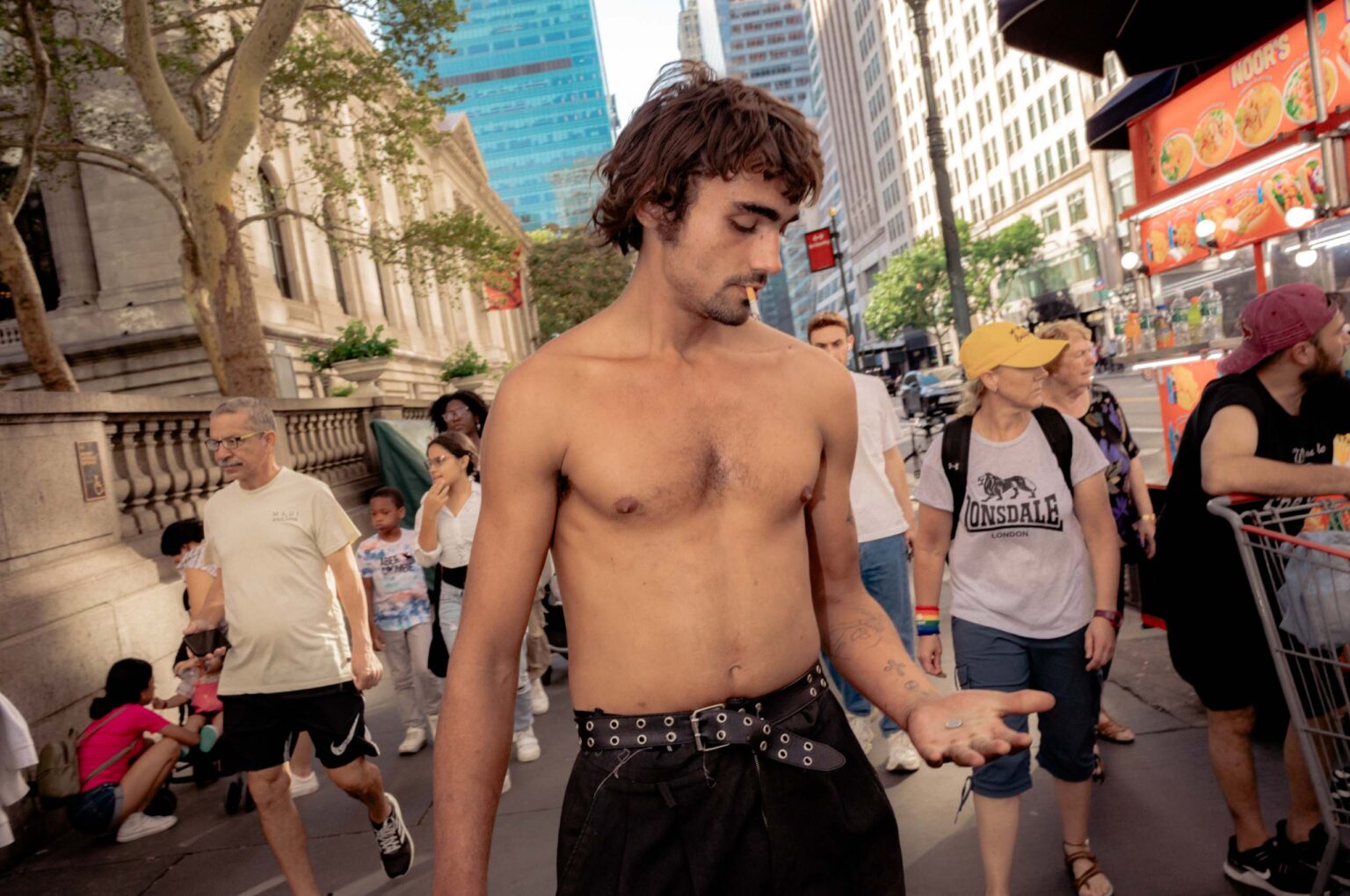
At 42nd Street and Fifth Avenue, a shirtless man stands with a cigarette in his mouth and several coins in his open palm. He looks down. Pedestrians cross behind him, the stone facade of the New York Public Library rises at the left, and a food cart closes the right side of the frame.
I titled the photograph Decision Time. That title changes the picture. It turns a visible action, looking at coins, into a story about choosing among possibilities. The inference may be reasonable, but it is still an inference. He could be counting the coins, selecting one, showing them to someone outside the frame, or pausing for a reason the photograph cannot recover.
The temptation is to push further. A bare torso, loose coins and a Midtown sidewalk can be made to signify precarity, survival, chance or fate. Those ideas may describe what the photograph activates in a viewer, but they do not establish the man’s circumstances or state of mind. When interpretation is presented as fact, an unresolved person becomes a convenient symbol.
A caption is a second shutter. The camera cuts one visible moment from the street. The caption cuts one reading from the meanings that moment might support. Dates, locations, titles, keywords and categories continue the work by deciding how the image can be found and what it will sit beside. The archive is already interpreting before anyone writes an essay about it.
Accountable interpretation does not require timid captions or the abandonment of metaphor. It requires a clearer distinction between description, inference and projection. “He is looking at coins” describes the photograph. “He is deciding” names my reading. “He is deciding how to survive” claims knowledge the frame does not provide. The ethical task is not to stop interpreting. It is to remain accountable for who is doing the interpreting.
III. The Archive Includes the Photographer
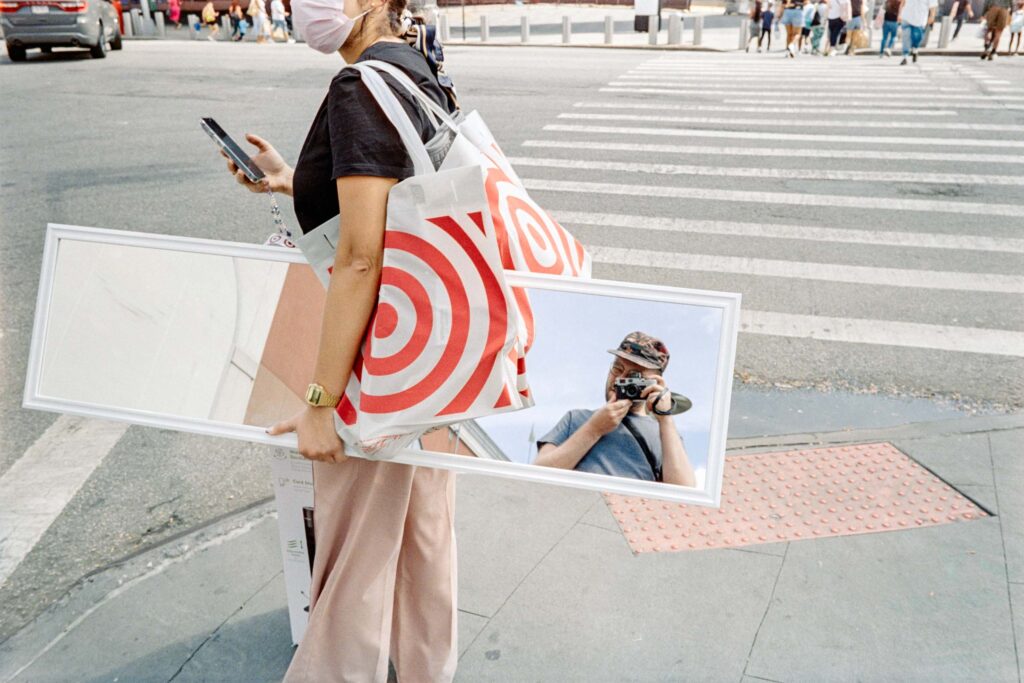
In another photograph, a woman crosses the street carrying a long mirror, a Target bag and a phone. The mirror turns toward me as she moves. Inside it, I appear with the camera raised. The street produces a self-portrait through an object another person happens to be carrying.
The picture makes authorship literal. I am not a detached eye floating outside the scene. My body has a location, my camera announces an intention, and my presence becomes part of what the photograph records. The woman’s movement creates the reflection, but I choose the instant, preserve it, title it and publish it.
That relationship is reciprocal without being equal. A stranger can redirect my attention or change the picture through a glance, gesture or carried object. Yet the power to select and circulate the result remains mine. Describing the city or camera as a collaborator can be useful shorthand, but it must not conceal the human decisions behind the image.
Including the photographer in the archive does not make every photograph autobiographical. It makes every photograph situated. The collection records what happened in front of me and how I repeatedly chose to meet it. Over time, it becomes evidence of my access, preferences and blind spots as well as evidence of the city.
IV. Walking Produces the Sequence
No single frame can carry an urban archive. The idea becomes credible only through accumulation. I walk, return, recognize a corner, notice what has disappeared and photograph a familiar place under a different pressure. A storefront closes. Scaffolding goes up. A repeated gesture becomes visible as a social habit rather than a private exception.
In The Practice of Everyday Life (opens in a new tab), Michel de Certeau treats walking as one of the ways people actively make use of an organized city. Streets may be planned from above, but they are lived through routes, detours, shortcuts and refusals at ground level. Photography adds another layer to that practice. The sequence of pictures is a record of movement through space, not a survey made from nowhere.
A route also establishes the archive’s limits. I photograph the streets I can reach at the hours I am available. Familiarity may sharpen my attention, but it can also make recurring conditions invisible. Repetition does not automatically produce authority. It produces a pattern of looking that must itself be read.
Editing turns that pattern into an argument. Two photographs made years apart can reveal a change that neither explains alone. A cluster of gestures can suggest how a particular space is used. An image once dismissed can become central when later work gives it context. The archive remains alive when sequence is understood as provisional rather than final.
Revision is part of the practice. I can correct a date, replace an inflated caption, restore missing context, remove a misleading sequence or admit that an earlier interpretation asked too much of a stranger. An archive that cannot accommodate correction is not living. It is merely defended.
V. The Viewer Reopens the File
Once a photograph circulates, it enters times and contexts I cannot control. A later viewer may know what became of a building, recognize a uniform I treated as ordinary, or see a social code that escaped me. The same image can move from a personal edit to a book, exhibition, website or historical record. Each setting changes the questions placed around it.
This openness does not mean that every reading is equally persuasive. The visible facts still matter. A viewer may interpret the Park Avenue photograph through class, gender, labor or performance because the frame contains signs relevant to those concerns. The photograph cannot establish the private motives of the people pictured simply because a theory makes those motives sound plausible.
The distinction protects interpretation from becoming possession. A photograph can carry social meaning without turning its subject into a solved case. It can show how a person appears within a public arrangement while acknowledging that appearance is only one part of a life. The unknown is not a failure of the archive. It is evidence of the subject’s excess over the record.
The viewer therefore does more than complete a message I began. The viewer tests the photograph against another time and another body of knowledge. Sometimes that encounter extends my reading. Sometimes it exposes a projection or omission. A living archive must permit both.
VI. What a Living Archive Demands
Return to Park Avenue. The woman remains close to the camera. The doorman still turns away. The white pedestrian figure still grants permission to cross. The photograph preserves a real configuration of bodies, work, property and movement in New York in 2023.
It still does not tell me the woman’s story. Nothing is gained by pretending that it does. The picture’s force comes from the tension between what it records precisely and what it cannot know. That tension is not an obstacle to interpretation. It is the condition that keeps interpretation honest.
To treat the city as a living archive is therefore to accept several obligations. Describe before diagnosing. Mark the point where observation becomes inference. Preserve dates, places and sequences that may matter later. Make room for correction. Remember that a public image of a stranger does not make the stranger fully available to us.
Street photography turns brief encounters into durable records, but durability is not closure. The photograph remains available to new contexts because the event and the person were never exhausted by the frame. The city stays larger than the archive we make from it. The archive is alive only while our readings remain answerable to that fact.
Construction hoardings make accidental frames, and a record of what’s behind them: The City Behind the Wall. Hauntology works the same seam.
Works Cited & Further Reading
Sources supporting the essay’s account of photographic presence, urban walking, framing, captioning and the production of public memory.
- Barthes, Roland. Camera Lucida: Reflections on Photography (opens in a new tab). Translated by Richard Howard. Hill and Wang, 1981.
- de Certeau, Michel. The Practice of Everyday Life (opens in a new tab). Translated by Steven Rendall. University of California Press, 1984.