Lisette Model and the Cruelty of the Frame
Lisette Model’s close, abrasive photographs made bodies feel impossible to evade. Her long-shelved jazz project reveals that the familiar “cruel camera” was only one part of the work—and that an artist’s reputation can itself become a crop.
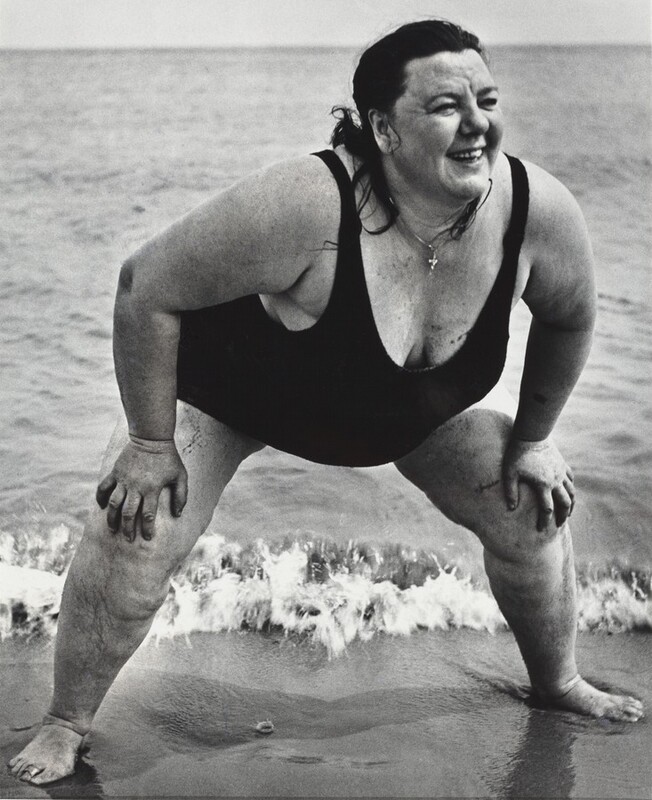
Lisette Model’s Coney Island Bather stands at the edge of the Atlantic with her feet planted wide in the surf. Her knees are bent. Her hands press against her thighs. The horizon runs behind her shoulders, but the body almost erases the beach. She is laughing, or calling out, or doing both at once. Nothing about her asks to be made smaller.
According to Model’s later account, the woman initiated the encounter. “Lady, take a picture of me!” she called. When people nearby began to snicker, the bather herself answered them: “Have you never seen a fat woman?” The exchange, preserved by the National Gallery of Canada, complicates the photograph before we have even left its surface.
This is a portrait built from invitation and pressure. One part belongs to the woman, who offers herself to the camera as a public performance. Another belongs to Model, who turns that performance into a forceful rectangular fact. The invitation matters. So does the crop.
Model’s reputation has tended to settle on the second part. Her photographs are described as blunt, abrasive and cruel. The charge is not baseless. She enlarged bodies until they crowded the frame, isolated gestures from their surroundings and made class, appetite, age and physical difference difficult to look past. Her pictures do not offer the consoling distance of good manners.
But cruelty is an incomplete account of what her camera could do. The 2025 publication of Lisette Model: The Jazz Pictures brought forward a substantial body of warm, kinetic photographs from a book project Model shelved amid McCarthy-era political pressure. Those pictures do more than add an unfamiliar chapter. They expose how much of the familiar Model was built from the work that remained in circulation.
Her real subject was not eccentricity. It was what happens when social performance meets a forceful frame. She photographed people constructing themselves in public, then used cropping, scale and timing to make that construction visible. The method could produce satire, intimacy, abstraction or joy. It could also turn a person into a type.
To look at Model now is to consider two kinds of cropping. One happens inside the photograph. The other happens around an artist’s career.
I. The Frame Gets Closer Afterward
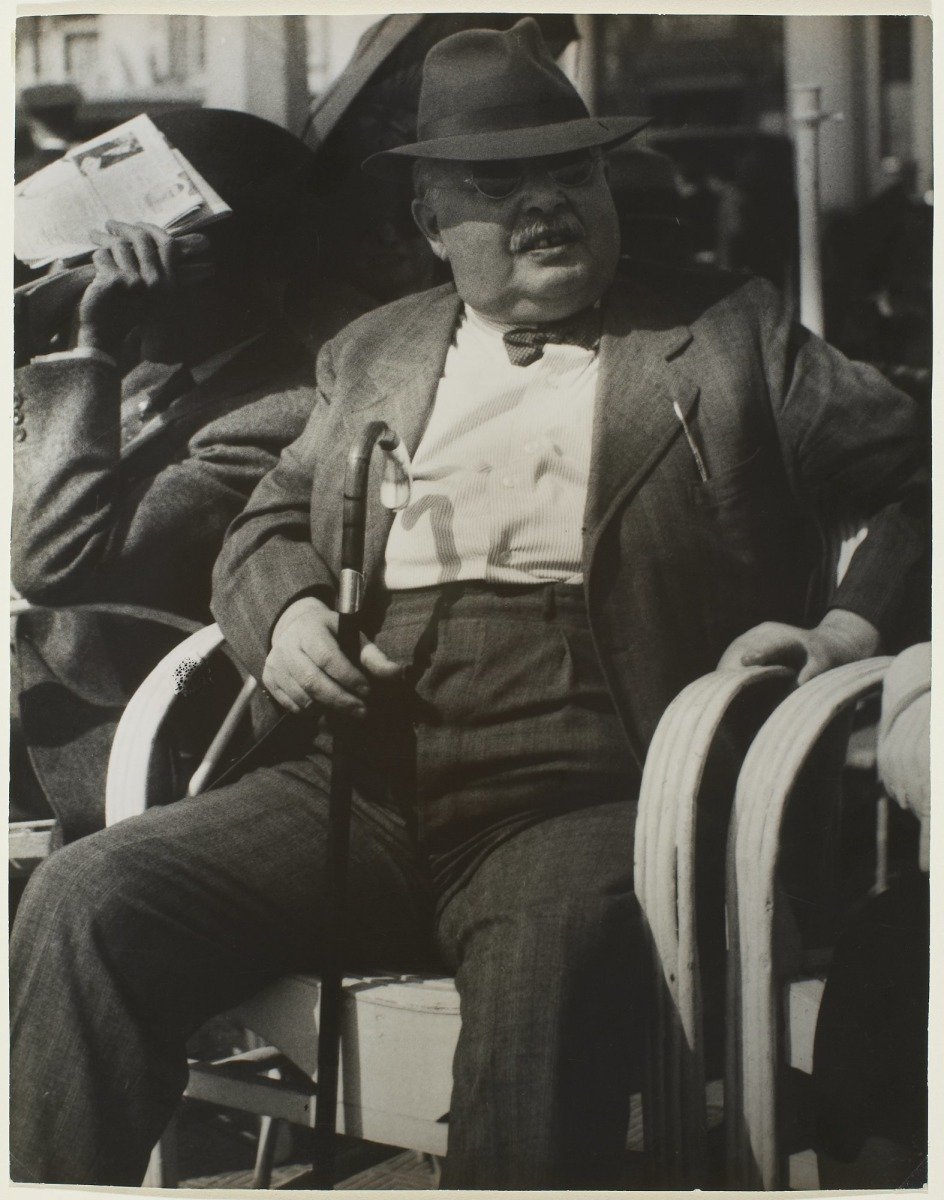
In Promenade des Anglais, Nice, a seated man fills almost the entire photograph. His hat, sunglasses, mustache and bow tie make a compact theater of respectability. A walking stick rises between his hands. His legs spread toward the lower corners while the wicker chair seems barely able to contain him. Behind his shoulder, another vacationer disappears into a newspaper.
The picture feels physically confrontational. We seem to be standing too close.
That closeness, however, was not simply a fact of the encounter. For Model, the negative was an “initial sketch.” Cropping and enlargement were part of making the picture, not repairs performed after it. Curator Ann Thomas puts the point plainly: “She did all the outrageous stuff in the darkroom.” The National Gallery’s study of Model’s process shows how edges were removed and angles exaggerated until the final print carried more pressure than the original exposure.
The distinction matters. A close photograph is not always evidence of a close relationship. Apparent proximity can be constructed afterward.
Model’s crop removes the seated man’s avenues of retreat. It converts posture into argument. His body, clothing and leisure become one public display of class. The photograph does not merely discover something ridiculous in him. It manufactures a visual condition in which every detail presses forward at once.
She returned to the same strategy throughout the Promenade des Anglais series. In another picture, a woman sits upright in a patterned dress with pearls at her neck, a dark hat above her face and a small dog gathered into her lap. An empty wicker chair opens beside her like a vacant place in the performance. Her chin is raised. The dog’s eyes and hers appear to meet the camera with different versions of the same suspicion.
These people are not caught without a public identity. They arrive armored in one. Model’s frame makes the armor conspicuous.
The print itself could intensify that effect. Model treated the negative as a starting point, cropping and enlarging in the darkroom; later prints of works such as Promenade des Anglais were also produced at substantially larger scale than earlier examples. Audrey Sands’s Getty Research Journal study places those later prints within the 1970s market for limited-edition photographic portfolios. The final object did not simply preserve an encounter. It entered a new material and institutional life.
Cropping, then, was an ethical structure as well as a formal decision. It redistributed power after the encounter had ended. Model could make a stranger appear nearer, louder and more exposed than the stranger had been in front of her camera.
II. Cruelty Is Not One Thing
The cruelty attached to Model’s work often begins with bodies. She photographed people whose size, age, gestures or expressions violated the narrow terms of public decorum. Her images do not conceal those differences behind a soft language of dignity. They insist on physical presence.
That insistence can be punitive. It can also expose the cruelty already operating around the subject.
The Coney Island bather is a useful test. Model’s crop makes the woman’s body monumental, but the woman’s performance is already large. She plants herself before the camera. She laughs. She commands attention. The picture’s force does not depend on catching her unaware. It begins with her decision to be seen.
The bystanders’ laughter clarifies the social field. Their response treats the body as a public violation. The bather’s response refuses the premise that she should be embarrassed; Model’s photograph preserves that defiance while giving it a new public life. Yet the photograph cannot permanently control the meaning of its own circulation. Viewers can still turn the bather into a spectacle, and histories can still reduce her to a category.
Agency at the moment of exposure does not guarantee agency in reception.
This is the difficult center of Model’s portraiture. A photograph can preserve a person’s performance while also conscripting it into the photographer’s. Recognition and appropriation do not cancel one another. They can occur in the same frame.
Model applied visual pressure across different social settings. Vacationers in Nice, crowds on the Lower East Side, nightclub patrons and Coney Island bathers all entered the same field of intense scrutiny. That breadth matters, but equal intensity is not the same as equal power. The people she photographed did not all enter public circulation with the same social position or control over how their images would travel.
The pictures do not solve that imbalance. They make it active.
Calling Model cruel can become its own kind of simplification if it treats cruelty as a personality trait that explains every image. The more useful question is where the photograph places pressure, who can answer it and what the frame allows us to forget. Sometimes Model’s pressure punctures self-importance. Sometimes it amplifies a subject’s defiance. Sometimes it converts a complicated person into a visual type.
The charge of cruelty is neither a final verdict nor a mistake. It names the risk built into her method.
III. The City Breaks the Body Apart
Model’s reputation rests so heavily on faces and bodies that it can obscure how often she allowed the city to dismantle both.
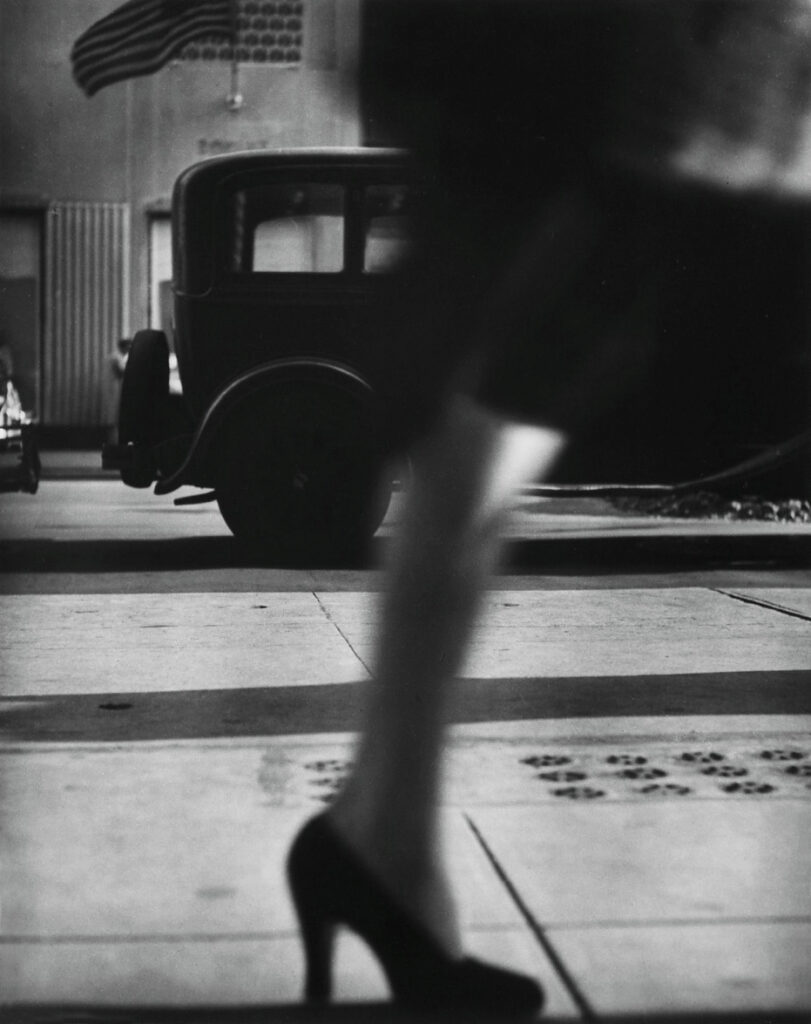
New York. c. 1940-1941
In Running Legs, Fifth Avenue, New York, a woman’s lower leg cuts through the foreground. The heel is raised, the calf blurred and the rest of the body absent. A car waits behind her. Hard sunlight divides the pavement into bands of brightness and shadow. The photograph has no face and offers no stable character. A person becomes an event.
The crop no longer enlarges a social type. It turns movement into urban syntax.
Her Reflections photographs perform a related transformation. Storefront glass stacks architecture, vehicles, signs and bodies into unstable layers. A dark silhouette may occupy the same visual plane as a bright column. The city refuses to hold still long enough to become background. It writes across everyone passing through it.
These pictures expand Model’s project beyond psychological portraiture. Identity appears as an arrangement of surfaces, speeds, costumes and gestures. A body can become a fragment. A street can become a face. Description gives way to collision.
Model had studied music in Vienna, including piano under Arnold Schoenberg, before turning to photography. Music does not explain the photographs, but it offers a useful way to understand their organization. Running Legs has a beat. The Reflections pictures syncopate. Repetition establishes order, then an interruption makes the order visible.
That structure also runs through her teaching. Model resisted formulas and asked students to develop a responsive relation between eye, camera and world. Her notebooks called for “no rules, no preconceived ideas, no applied formulas”. Seeing was not the application of a style. It was a way of discovering what the picture had made available.
The city photographs make the stakes of that discovery clear. Model did not use the camera to summarize people. She used it to detect collisions between bodies and the visual systems around them.
She photographed the social world as composition without pretending composition was innocent.
IV. The Warmth the Canon Left Out
For more than a decade, Model photographed jazz musicians, performances, rehearsals and after-parties. Louis Armstrong, Billie Holiday, Duke Ellington, Miles Davis, Dizzy Gillespie and Bud Powell appear across the project. A book was planned with an essay by Langston Hughes. It did not appear.
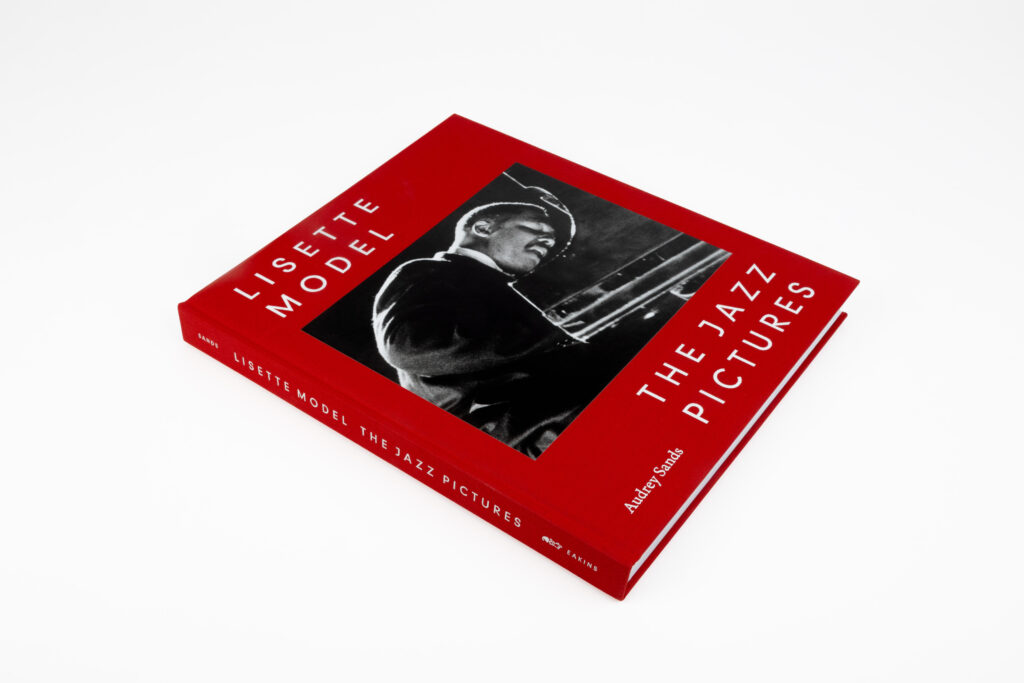
The photographs finally received sustained publication in the 2025 volume Lisette Model: The Jazz Pictures, by Audrey Sands. They alter the emotional range of Model’s work.
In one photograph, Armstrong rises from a low angle with his trumpet crossing the frame. His face opens into a broad smile while another instrument enters from above. The image is crowded, bright and physically close. Nothing settles into the static scrutiny associated with Model’s street portraits. The frame moves with the performance.
In a photograph of Bud Powell, the pianist leans toward the keyboard as if the instrument were pulling his whole body forward. Light catches the rim of his head and shoulder while most of the room falls away. Model’s familiar devices remain. The crop is tight. The angle is forceful. The tonal range gives the body weight. The social temperature is different.
Many of the jazz pictures register warmth, concentration and collective pleasure. They do not support a neat division in which the street photographs are cruel and the music photographs are kind. The Eakins Press publication describes the series as effusive and empathetic; the pictures themselves remain varied. Their importance here is that Model’s formal intensity was not locked to one emotional register.
The crop could pressure a body. It could also amplify rhythm and shared exhilaration.
Model’s musical education makes the project feel less like a detour than a return. She later said, “I was absolutely overwhelmed by jazz because I knew that was America.” The remark, cited in The Atlantic, does not describe a detached observer collecting another social type. It describes recognition.
The jazz photographs place her inside an American culture being made in public. They show a photographer responsive not only to the exposure of performance, but also to its pleasure.
V. How Repression Cropped an Artist
The absence of the jazz project was not an ordinary editorial delay.
During the 1950s, the Photo League came under federal scrutiny for alleged Communist ties. Model was interviewed by the FBI and eventually placed on its National Security Watchlist. According to Eakins Press, mounting political pressure led publishers and funders to withdraw support, and Model ultimately shelved the jazz book she had planned with an essay by Langston Hughes.
That absence shaped the artist who entered history.
Without the jazz photographs, later viewers encountered a narrower Model. The severe street portraits, bodily fragments and caustic Riviera pictures remained visible. The warmth, musical identification and sustained attention to collective Black performance did not circulate beside them at the scale she had intended.
The familiar description of Model as a cruel photographer was reinforced by the work that remained easiest to see. The surviving public record was not neutral: one substantial project had been pushed out of circulation by political pressure.
This does not make the familiar pictures less forceful or release them from ethical scrutiny. It changes the ground of interpretation. An artist’s reputation is not a neutral summary of the best work. It records what editors, publishers, museums, markets and governments allowed to travel.
The historical frame performs an operation similar to Model’s crop. It closes around selected forms until they appear to be the whole subject. What falls outside can cease to exist publicly.
The 2025 book cannot restore the reception the jazz photographs might have received in the 1950s. It can show that the established story was partial. It can also reveal how quickly a formal tendency becomes a moral identity when contradictory work disappears.
Every photographic edit makes a claim. Over time, some edits become history.
VI. The Archive Thinks Back
The National Gallery of Canada holds Model’s archive, including roughly 25,000 negatives alongside contact sheets, notebooks and correspondence. That scale matters because an archive can argue with the finished career. It retains abandoned paths, repeated gestures and bodies of work that a public reputation has no place for.
Model’s archive does not reveal a gentler “true” artist hidden behind a cruel one. It reveals a more unstable practice. Satire and admiration coexist. Constructed proximity can feel invasive in one picture and ecstatic in another. A body can become a type, a performance, a rhythm or an interruption.
Her influence is often narrated through the photographers she taught, especially Diane Arbus. Her students also included Larry Fink, Peter Hujar, Bruce Weber and Rosalind Fox Solomon. The National Gallery’s account of her teaching records her insistence on “no rules, no preconceived ideas, no applied formulas.” Her legacy was not a list of approved subjects. It was a discipline of attention without a formula.
Reducing that influence to an appetite for unusual people repeats the problem of her reputation. It mistakes a visible recurrence for the full method.
The more demanding inheritance is uncertainty. Model’s photographs accept that an image can know something the photographer does not, then force the photographer to take responsibility for the form that knowledge assumes. The negative may begin as evidence. The crop, print, sequence and archive decide what kind of evidence it becomes.
Return to the Coney Island bather. At first she appears as bodily audacity. The story of the encounter adds invitation. Model’s darkroom practice adds constructed pressure. The history of the jazz archive adds another Model, one whose intimacy with performance was larger than the canon allowed.
None of these meanings cancels the others.
The woman remains at the center of the frame, laughing into a public gaze that had already tried to shame her. Model meets that performance with an image forceful enough to remain unsettled.
Model’s frames close hard around their subjects. Her archive has spent the decades since reopening them.
The city breaking the body into parts is how Oral Fixation got made, and most of Body & Gesture with it.
Works Cited & Further Reading
- Eakins Press Foundation. Lisette Model: The Jazz Pictures. By Audrey Sands, with texts by Langston Hughes and Loren Schoenberg, 2025.
- Markovic, Mina. “Closeness of Eye and Camera-vision: Lisette Model as a Teacher.” National Gallery of Canada, 2022.
- Museum of Modern Art. “Lisette Model: Running Legs, 1940–41.” Collection record.
- Sands, Audrey. “Lisette Model: Twelve Photographs: The Limited-Edition Portfolio and the Market for Photographic Prints in the United States.” Getty Research Journal, no. 20, 2025.
- Stauble, Katherine. “Preserving Model’s Legacy.” National Gallery of Canada, 2015.
- National Gallery of Canada. Coney Island Bather, New York, c. 1939–July 1941, printed later; and Promenade des Anglais, Nice, c. 1934, printed c. 1940–49.
- The Atlantic. “What Lisette Model Saw in Jazz.” October 2025.