Robert Adams and the Moral Burden of Beauty
Robert Adams did not use beauty to redeem the damaged American West. He used it to keep us looking at what our appetite for progress had made.
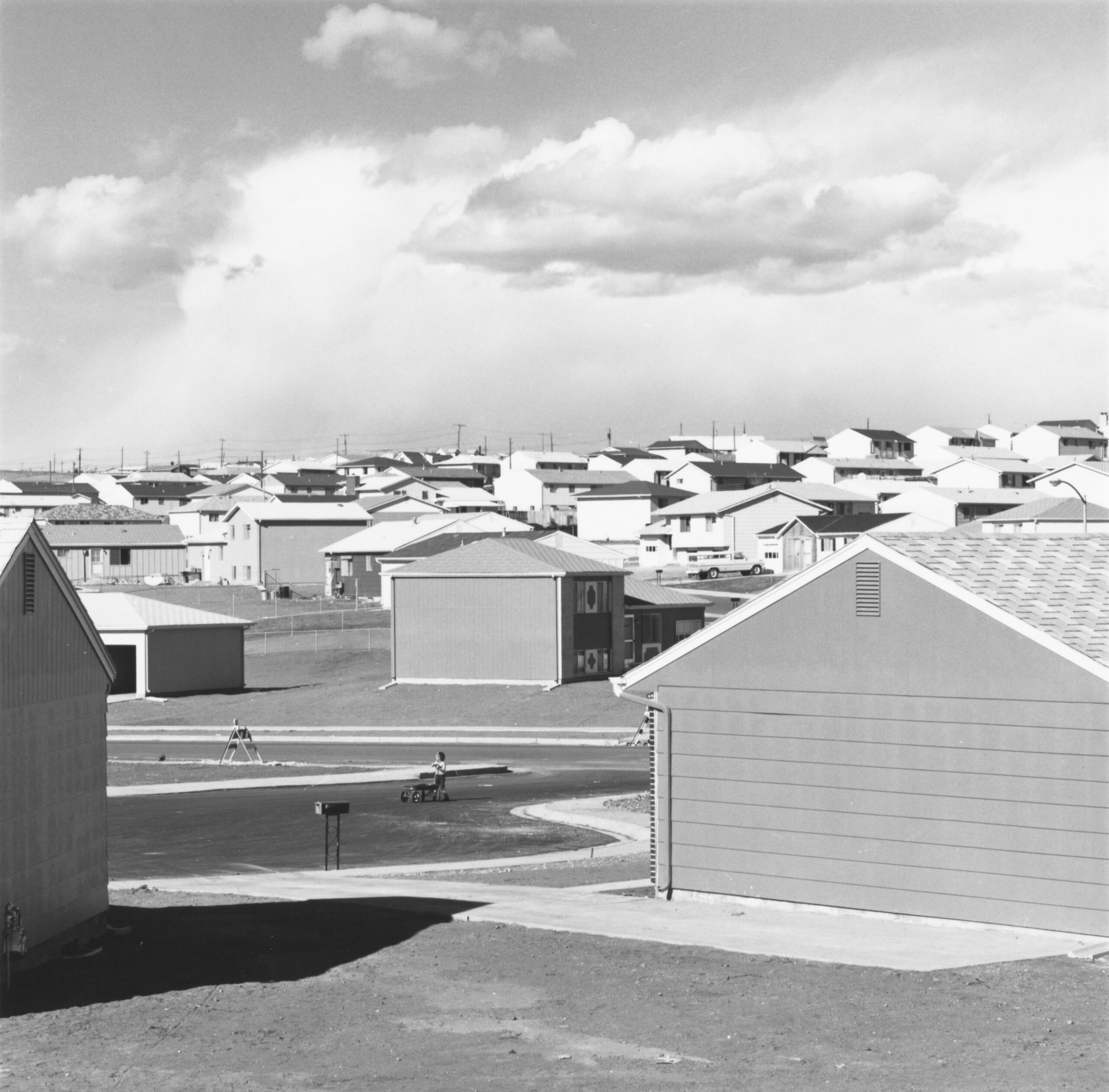
In Robert Adams’s Pikes Peak Park, Colorado Springs, Colorado (1969), peaked roofs spread almost to the horizon. Two houses close around the foreground like walls. Between them, a child pushes a small wagon or toy stroller across a new street. Above the subdivision, clouds occupy half the square frame.
The photograph contains no spectacular disaster. The houses are intact. The sky is bright. A family has acquired a home, and a child has room to play. Yet the development appears both expansive and airless. Repeated roofs replace any clear view of the land that made this place desirable. Pikes Peak is named but not visible.
Adams gives the scene more beauty than an indictment requires. The roofs form a precise visual rhythm. Light separates every plane. The clouds lift the picture toward something spacious and almost consoling. That beauty is not a retreat from the environmental argument. It is the source of its pressure.
Robert Adams did not use beauty to redeem the damaged American West. He used it as a discipline of attention, keeping us with landscapes our idea of progress had compromised. His restraint is not neutrality. It is a refusal to let either outrage or consolation monopolize what the land has become.
I. The West After Eden
When Adams began photographing Colorado in the mid-1960s, the mythology of the American West still depended on distance. The landscape appeared most purely itself when cities, roads and ordinary residents were kept outside the frame. Wilderness photography offered grandeur by editing out the systems that made modern Western life possible.
The New West, published in 1974, reversed that arrangement. Adams photographed tract houses, commercial strips, mobile homes, parking lots and the raw dirt left by rapid construction along Colorado’s Front Range. These were not interruptions surrounding the real West. They were the West Americans had made.
A year later, his photographs appeared in New Topographics: Photographs of a Man-Altered Landscape. The exhibition became associated with a cool, descriptive style that rejected the heroic landscape. That history matters, but “deadpan” is an inadequate account of Adams. His frames are controlled, not emotionally empty. He does not merely register development. He asks what kind of life its order makes possible.
The distinction is visible in Pikes Peak Park. The child prevents the subdivision from becoming an abstract diagram of sprawl. People sought these houses for understandable reasons. They wanted space, privacy, safety and proximity to nature. The resulting environment made nature harder to reach and community harder to see.
The resulting account is not a balanced perspective in which development and preservation receive equal time. Adams’s subject is contradiction. The same promise that draws people west helps consume the landscape they hope to enjoy. The damage is not imposed by a distant villain. It is built through recognizable desires, public policy, inexpensive construction and the ordinary wish for a better life.
By photographing that contradiction without caricature, Adams makes it harder to assign innocence. The new houses are neither monsters nor neutral facts. They are evidence of how aspiration becomes geography.
II. Light Does Not Forgive
Adams’s most difficult subject is not suburban development. It is light. In his writing on The New West, he identified light as the source of form. That claim changes the environmental meaning of his pictures. Light does not distinguish between an undamaged prairie and an asphalt road. It clarifies both.
Burning oil sludge, north of Denver, Colorado (1974) makes the problem explicit. Dark smoke spreads above an oil pump and a leafless tree. Snow and distant mountains remain luminous beneath it. Pollution does not cancel beauty, and beauty does not make the pollution less poisonous.
A weaker environmental photograph would force the scene into a single emotional register. It might make destruction grotesque enough to secure condemnation or make the mountains sublime enough to offer escape. Adams holds both together. The smoke is visually commanding because the atmosphere and snow give it form. The viewer’s attraction becomes ethically uncomfortable.
The photographs later revised and published as Summer Nights, Walking extend that instability. Made between 1976 and 1982, they turn sidewalks, trees, distant gas stations and suburban edges into scenes of wonder, anxiety and stillness. Darkness removes the daytime confidence of Adams’s surveys. Familiar places become alluring and uncertain.
Light, then, is not a metaphor pasted onto the land. It is the condition that makes judgment possible while refusing to simplify what judgment finds. It reveals the damaged world as still beautiful. That is more accusatory than ugliness. A world stripped of beauty can be abandoned. A beautiful world damaged by ordinary appetite leaves us responsible for what remains.
III. Restraint Is a Position
Adams’s formal restraint is often mistaken for an absence of argument. His horizons are stable. Buildings remain legible. Black-and-white tonal differences separate sky, concrete, grass and wood without theatrical distortion. The pictures rarely perform outrage for the viewer.
But description is never neutral. Adams chooses where to stand, what to exclude and how much sky a development receives. He decides when one house becomes a pattern and when a person becomes the measure of that pattern. His calm surfaces control the terms on which environmental change can be seen.
Sequence strengthens that control. In books such as What We Bought: The New World, individual pictures of roads, commercial buildings, new houses and vacant ground accumulate into a system. No single frame has to symbolize consumer culture. Repetition reveals how consumer culture organizes space.
This serial method also refuses the spectacle of exceptional catastrophe. Environmental damage usually arrives through permits, purchases, commutes and construction schedules. It becomes ordinary before it becomes historically visible. Adams’s quiet pictures match that tempo. They ask us to notice a transformation precisely because it does not announce itself as crisis.
The National Gallery of Art titled its 2022 retrospective American Silence. Silence in Adams’s work has two meanings. It is the stillness produced by light on a prairie, in woods or beside the ocean. It is also the civic silence that permits the desecration of those places. The photographs do not resolve the difference. They make reverence and complicity occupy the same visual field.
Restraint is therefore not a refusal to judge. It is a refusal to let style complete the judgment for us. Adams supplies visible evidence and enough formal beauty to sustain attention. The moral pressure develops slowly, after the first pleasure of seeing.
IV. People Beside an Invisible Catastrophe
Our Lives and Our Children changes the ethical structure of Adams’s work. Made near the Rocky Flats nuclear weapons plant outside Denver around 1980 and 1981, the series shows people in shopping-center parking lots. The danger it addresses is largely absent from the frame. Plutonium cannot be read in a face or detected in the bright space surrounding a parked car.
According to the Getty’s project account, Adams left his tripod behind, strapped a camera to his wrist and concealed it behind a grocery bag. He worked like a street photographer so that the people around him would not become self-conscious before the lens.
That method should not be converted too quickly into evidence of humane intent. The people did not know they were participating in an environmental argument. Adams gained an unguarded appearance by withholding the encounter. The photographs retain that ethical discomfort even when their larger purpose is urgent.
What they show is not a population visibly broken by catastrophe. Adults shop, speak and care for children. Ordinary affection continues near a facility capable of destroying the future it appears to secure. The series locates hope here, not in proof that everything will be fine, but in the value of lives that policy has placed at risk.
The invisible threat also clarifies why Adams resists spectacle. A dramatic image of fire or contamination might isolate disaster as an exceptional event. These parking lots show catastrophe as administration. It exists beside errands, employment and family continuity. The ordinary scene is not less political because it lacks visible damage.
Adams’s landscape has never been empty. Even when people disappear from the frame, roads, fences, houses and cleared land record their choices. In Our Lives and Our Children, human presence becomes explicit, and environmental responsibility becomes intimate.
V. Hope Is Not Reassurance
The live essay repeatedly describes nature as resilient. Adams’s work offers no such easy reassurance. Survival is not recovery, and a remaining tree does not excuse the system that cleared the orchard around it.
In Los Angeles Spring, made during repeated visits between 1978 and 1983, birds, eucalyptus trees and unexpected verdancy persist amid smog, defoliated orchards and postwar development. The life in these pictures is not evidence that nature will repair whatever people do. It identifies what remains available to love and therefore to lose.
Later projects make that distinction harsher. Turning Back addresses the timber industry’s destruction of Northwestern forests. Tenancy, made from 2013 to 2015 along Oregon’s Nehalem Spit, moves among washed-up stumps, a narrow sanctuary of trees and dunes, and the ocean beyond. Its title refuses ownership. People occupy the land temporarily, even when their damage outlives them.
Hope in Adams is not optimism about human behavior. It is the decision to continue looking after innocence is impossible. His photographs wager that sustained attention can become a form of responsibility. They do not demonstrate that responsibility will be accepted.
Because life continues inside the damaged landscape, beauty and grief cannot be separated in his work. Grief without beauty turns the landscape into a corpse whose fate has been decided. Beauty without grief becomes decoration. Adams needs both because the damaged world is neither dead nor safe.
VI. The Moral Burden of Beauty
Return to the child in Pikes Peak Park. The small figure is easy to miss among the roofs, driveways and bare ground. Once noticed, the child reorganizes the photograph. The subdivision is no longer only an example of sprawl. It is a world being inherited.
The enormous sky makes that built world appear temporary, but temporariness does not cancel consequence. The houses have altered the land. Their repetition has narrowed the horizon. The child will learn this environment as ordinary.
Adams’s achievement lies in refusing the two easiest responses. He does not give us a pristine West to mourn from a safe distance. He does not give us a ruined West from which hope has become naïve. He photographs the compromised place where people actually live and asks what kind of attention living there requires.
For photographers, the lesson is not simply to compose carefully or wait for expressive light. It is to understand that formal beauty creates obligations. A clear frame can expose a system without pretending to stand outside it. A sequence can make ordinary change historically visible. Light can hold our attention without forgiving what it illuminates.
Robert Adams’s photographs do not reconcile beauty and damage. They make the coexistence of both impossible to evade. Beauty is not the reward for looking past the damage. It is what makes looking away indefensible.